
Xona has cleared its final regulatory hurdle — the FCC has authorized full deployment of Pulsar, its 250+ satellite constellation and the first private network cleared to broadcast navigation signals alongside GPS.
Landscape partnered with Xona to establish category leadership in precision navigation, building a brand around “Navigational Intelligence” — a futuristic visual system and technical infographic style that signal Xona’s advantages over legacy GPS: absolute precision, superior signal power, and robust encryption.
The result is a foundational brand platform Xona’s team can execute from at the highest level — built to deliver compounding results as the constellation scales.
Category: News
Peak Featured in Wall Street Journal
A new The Wall Street Journal piece by Christopher Mims puts sodium-ion in the spotlight — welcome validation for Peak Energy, whose team has spent three years proving it’s fundamentally better in every way that matters for the grid.
As Peak prepared to exit stealth, Landscape partnered with their team to position the company as a category leader in low-cost, large-scale energy storage — framing sodium-ion as the reliable storage standard through a bold visual system of dynamic angular forms, a vibrant orange palette, and technical infographics that make the technology’s advantages clear.
The system offers Peak’s team a foundational platform from which to execute at the highest level – delivering compounding results.
Read the full article here.
Jake Dugard Joins Landscape as ACD
Landscape is excited to welcome Jake Dugard as Associate Creative Director.
Supporting the studio from the deep South, Jake brings over a decade of brand and campaign experience across health, tech, sport, and culture. His work is rigorous, distinguished by editorial modernism, generative graphics, and system-first branding.
Alongside his commercial career, Jake spent a decade teaching graphic design in higher education — developing curriculum, mentoring students, and earning tenure before returning full-time to studio work.
Antora Closes $550M in Series C
Antora Energy announced its closing on $550 million in Series C funding. The oversubscribed round was co-led by G2 Venture Partners and Eclipse, with participation from new investors including Ribbit Capital, Salesforce Ventures, Activate Capital, John Doerr, Westly Group, StepStone Group, and Liberty Mutual Strategic Ventures. Existing investors also contributed to the round, including Decarbonization Partners, Impact Science Ventures, Trust Ventures, Breakthrough Energy Ventures, and Lowercarbon Capital.
The Series C advances the company’s work to deliver affordable, reliable energy at the scale and speed that American industry and data centers require. The round will accelerate the deployment of large-scale projects across the country, enable Antora to expand production and establish a second U.S. manufacturing hub, and further strengthen the company’s domestic supply chain.
The announcement comes on the heels of the company’s deployment of one of the largest battery storage projects in the world, a 5 gigawatt-hour system in South Dakota that advanced from initial construction to delivering energy in under 12 months. Antora is now scaling that proven approach, with a growing pipeline of signed agreements with hyperscalers and industrial leaders.
“From factories to data centers, energy is the bottleneck to industrial growth,” said Andrew Ponec, Co-Founder and CEO of Antora. “Antora has shown we can help break that bottleneck—delivering energy fast, at massive scale, with American innovation. With this funding round, we’re continuing to strengthen our investment in U.S. manufacturing, delivering affordable energy across the country and around the world.”
Antora’s thermal batteries store low-cost electricity as heat in insulated blocks of solid carbon and deliver it around the clock as heat or power. The same factory-built modules can serve a chemical plant, a food producer, a steelmaker, a data center, or the grid, without supply-constrained critical minerals or multi-year construction timelines.
The result is a tool our energy system hasn’t had before: cheap, clean energy that’s fast to deploy and available around the clock. Antora’s batteries charge when electricity is abundant and deliver when it’s needed most, meeting surging energy demand from large new loads without raising costs for consumers.
“Antora has moved beyond proving the technology to demonstrating it can manufacture and deploy at remarkable speed and scale,” said Joe Fath, Partner and Head of Growth at Eclipse. “The Eclipse team has spent decades helping companies rapidly accelerate manufacturing and deployment, and Antora has the team, technology, and execution capabilities to become a foundational part of America’s energy infrastructure.”
“Our energy system is at an inflection point, and very few companies can meet soaring power demand,” said Jake Tauscher, Partner at G2 Venture Partners “Antora is meeting that demand today. They’re deploying at scale, on budget, and on the rapid timelines customers need. That’s how generational energy companies are built, and it’s why we’re proud to co-lead this round.”
Antora’s San Jose, California factory, which the company recently expanded into a three-building manufacturing campus, ranks among the country’s largest battery gigafactories. Unlike conventional batteries, Antora’s energy storage systems store energy for multiple days and are made of safe, abundant materials. Drawing on a workforce that includes welders, electricians, pipefitters, and machinists, Antora’s deployments have created and supported hundreds of American manufacturing and construction jobs.
“This financing unlocks a new phase of growth for Antora,” said Nehali Jain, VP of Strategy and Growth at Antora. “In 2024, we opened our U.S. factory, which is now one of the largest battery factories in the country. Earlier this year, we turned on one of the largest battery storage projects in the world. This funding round is how we deploy more projects, more quickly, across more sectors and geographies.”
Privy named Stablecon Most Influential 2026
Privy co-founder and CEO Henri Stern has been named to Stablecon’s Stablecoins Most Influential list for 2026.
Landscape partnered with Privy to evolve its brand as it scaled past 20M onboarded users — refreshing the identity system with new typefaces, colors, and a matured brandmark, and shaping messaging that positioned Privy as the fastest, battle-tested way for developers to bring every user, crypto-native or newcomer, onchain. The redesign coincided with an acquisition by Stripe shortly thereafter.
Congratulations to Henri and the Privy team on all the success and recent recognition.
Learn more about our work evolving brands for the companies building the future of onchain finance.
Shaped Acquired by Whatnot
Shaped, the machine learning company building real-time recommendation and search systems, has been acquired by livestream shopping platform Whatnot. The deal brings Shaped’s technology in-house as Whatnot strengthens discovery and personalization across a marketplace that now spans millions of buyers and a rapidly widening set of product categories.
Live commerce is a uniquely hard recommendation problem. Traditional e-commerce catalogs stay relatively stable; Whatnot’s marketplace changes by the second — inventory turns over, auctions end within minutes or run for hours, and buyer intent shifts across the span of a single show. The platform processes more than 500,000 hours of live video and millions of real-time interactions every week, and has spent six years cutting recommendation latency from roughly a day down to minutes. Shaped’s technology is expected to push that closer to real time.
Shaped founder and CEO Tullie Murrell will lead Whatnot’s newly formed Applied AI Research group, joined by nearly a dozen engineers and AI researchers. Shaped’s platform paired customer data with large language models and machine learning to power personalized search and discovery for companies including Outdoorsy and QVC.
The acquisition lands amid steep growth for Whatnot. Launched in 2019, the company recently passed 1 billion seller orders and raised $225 million in Series F funding at a valuation above $11 billion, adding 20 million buyers over the past year. It launched more than 35 new categories last year — art, golf, and vinyl among them — and more than 45 additional categories in the first half of 2026.
Every day, over 328M terabytes of data are created, fueling an endless stream of information. Shaped built a platform to power AI-driven recommendations and search, positioning itself as the essential infrastructure for transforming behavior into relevance.
To help Shaped stand out as a category leader, Landscape crafted an evolved brand and website that empowers developers to create intuitive web experiences in an infinite-content paradigm.
Antora Launches Project Big Stone
Antora is commissioning a 5 gigawatt-hour, multi-day thermal energy storage system at POET’s bioprocessing facility in Big Stone City, South Dakota. The deployment ranks among the world’s largest battery storage projects, delivered at the speed required to meet surging domestic energy demand.
Project Big Stone advanced from an empty lot to delivering energy in under 12 months. The landmark project, which will be completed later this year, deploys over 200 of Antora’s thermal batteries to deliver affordable, round-the-clock energy to POET—the world’s largest producer of biofuels—at their Big Stone City plant under a long-term energy offtake agreement.
Antora worked closely with Otter Tail Power—a utility that provides power at some of the lowest costs in the nation to customers across South Dakota, North Dakota, and Minnesota—to develop an innovative electric rate that enables the system to deliver 24/7 energy without increasing costs for other consumers. Approved by the South Dakota Public Utilities Commission last year, the rate allows the system to selectively and rapidly charge during periods of surplus local energy production, making better use of existing grid infrastructure. The structure offers a model for utilities across the country to rapidly integrate thermal energy storage while benefiting everyone on the grid.
Read more about the project here.
Peak Energy Partners With General Motors
Peak Energy and General Motors have announced a strategic partnership to scale next-generation energy storage for the grid, combining Peak’s grid-scale storage platform with GM’s battery and manufacturing expertise.To accelerate their market entry, Landscape partnered with Peak Energy to create a category-leading brand and site positioning their Sodium-Ion battery technology as the superior and reliable storage standard for industry-scale demand.
The bold visual system—featuring dynamic angular forms, vibrant orange palette, and technical infographics—establishes Peak as a critical player in building America’s energy future and resilient grid, supporting their mission to deploy giga-scale storage systems nationwide.
Accelerating early traction and driving demand for large-scale energy storage.
Bio-Based Wool: Variloom Partners With WoolSource
Variloom is partnering with WoolSource to unlock a new generation of bio-based materials for 3D-printed fashion. By pairing advanced manufacturing with Wool Source’s Cradle to Cradle Certified materials, they’re redefining what circular design can do—opening new opportunities for innovative and creative products.
To bring their innovation out of stealth, Landscape partnered with Variloom—a Moon Creative Lab venture backed by Mitsui—to define the foundational brand elements for their patent-pending 3D fabric printing system. Through global naming, identity, and messaging, we positioned Variloom at the forefront of advanced fabrication and circularity, capturing the system’s promise of print-to-shape flexibility, minimal waste, and fully recyclable performance textiles. The brand has since gained industry recognition, winning ISPO Awards alongside Rip Curl and YKK, and earning a spot on Fast Company’s 2025 Innovation by Design list.
Launching an innovation leader in 3D-printed fabrics and apparel circularity.
A Tasting Menu for La Digestion (or Love Songs for Alice Waters)
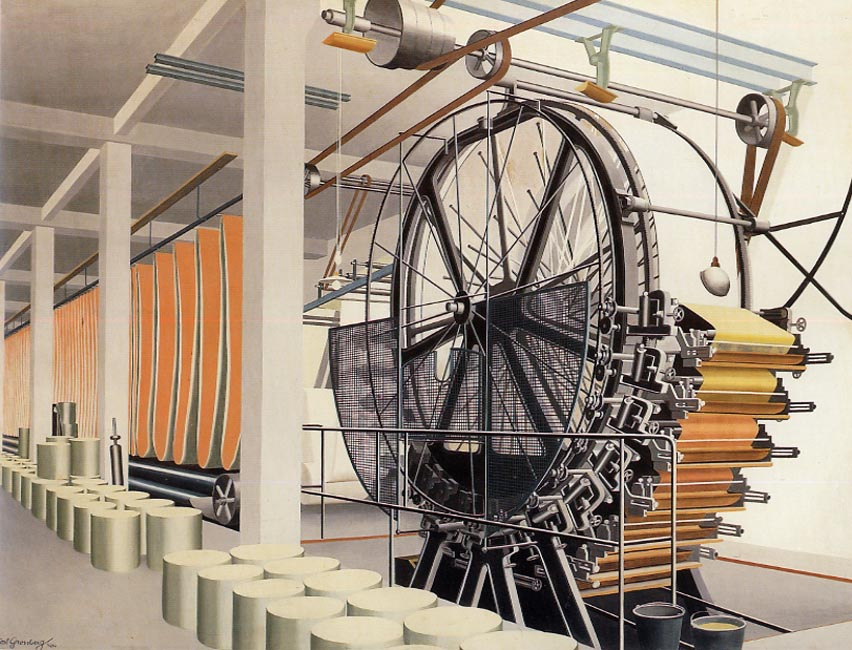
By Connor Tomaka, Laszlo Horvath, and Satya Paul
A Tasting Menu for La Digestion (or Love Songs for Alice Waters) is a pre-performance essay by Connor Tomaka, Laszlo Horvath, and Satya Paul, shared here as a prelude to their June 5th performance at DOG. Structured as a meal — courses, a digestif, a coda — it moves across the physiology of the singing voice, the digestion of culture, and the governance of creative ecosystems.
The performance follows. Join us Friday, June 5th for Music at DOG: La Digestion, an evening of live and recorded music centered on the modulation of voice. Doors at 7pm.
Get your tickets here.
Modal Raises $355M in Series C Funding
$355M raised. $4.65B valuation. Congrats to Modal on growing fivefold since September to surpass $300M in annualized revenue.
Modal started because the cloud built for traditional web applications was never going to fit AI workloads. This was clear to them before the GenAI revolution, and it becomes even more true as models and techniques advance.
Modal is a cloud built for AI. Not a single-purpose GPU cloud, but a platform with the right primitives for developers to build a very wide range of applications. Today, this looks like low-latency elastic inference, dynamic agent runtimes, reinforcement learning, batch jobs at massive scale, and much more.
To expand their adoption among enterprise teams, Modal needed a brand reflecting their product’s quality and transformative potential. Together, we developed an evolved identity and site showcasing their flexibility, scalability, and speed. The new brand has established Modal as the leader in serverless infrastructure, accelerating product adoption, funding, and solidifying their position in the developer ecosystem.
DataRobot in Wall Street Journal
DataRobot’s CPO was featured in Wall Street Journal making the case that real AI value comes from end-to-end workflow transformation, not individual productivity gains.
To help drive global expansion, Landscape worked alongside DataRobot’s leadership to craft a brand system that positions them as the unified, enterprise-grade AI platform — helping leaders scale AI to maximize business value while minimizing operational risk. With the evolved brand, DataRobot is reaching a more significant customer base and helping companies worldwide drive real business results with AI.
Watch the Panel: Taxonomy of Slop
For DOG [E23] Taxonomy of Slop, Ruby Justice Thelot delivered a compelling lecture arguing that AI slop isn’t a new phenomenon so much as the latest expression of dynamics that have been with us since the medieval fabliaux and Victorian penny dreadfuls.
Overview Signs Contract With Meta
Overview Energy just signed a 1 gigawatt-capacity reservation with Meta for space-based solar power — a landmark moment for the category.
To establish Overview as pioneers in space-based solar generation, Landscape partnered with their team to create a brand identity that frames continuous, directable energy as the answer to solar intermittency. The visual system — featuring a distinctive palette and custom animations — traces light’s journey from orbital arrays to Earth’s energy grids, while strategic positioning resonates with utility operators, data center developers, policymakers, and investors.
The new brand and site accelerate Overview’s path toward commercial deployment, establishing them as category leaders making abundant, on-demand solar from space a tangible reality.
Xona Raises $170M in Series C Funding
Congrats to team Xona on their $170M Series C. We’re proud to partner with Xona as they build the next era of satellite navigation and the future of positioning from orbit.
Over the past several years, Pulsar has moved from theory to real capability in space, achieving world-firsts in regulatory approvals and cryptography, setting records as the most powerful navigation signals ever broadcast, and proving precision positioning can reach existing GPS devices.
Our $170M in Series C funding coincides with the beginning of scaled manufacturing at our new Burlingame facility to launch our entire constellation over the coming years.
Gravity Featured in Forbes
Our client Gravity was featured in Forbes on why the operational case for acting on energy and emissions data holds regardless of regulatory cycles. Worth a read.
To help accelerate traction, Landscape partnered with Gravity to create a bold visual system and digital experience that resonates with industrial operators positioning Gravity as the essential SaaS platform for reducing emissions and competing in a planet-positive economy.
Gantri Featured in Inc.
Congrats to Gantri and Ian Yang on the Inc. feature. Proud to partner with a team proving that 3D printing at scale isn’t just possible — it’s the future of thoughtful design.
To expand their customer base, Landscape partnered with Gantri to create a refreshed brand system connecting sustainable, 3D-printed lighting with modern wellness. The work—spanning content strategy, creative direction, and a graphic system across web, social, and campaigns—positioned Gantri as essential to thoughtful living, driving a 108% boost in product views, an 17% rise in orders, and year-over-year sales growth. We’re excited to keep working with their team.
Read the article here.
The Kelsey Featured in New York Times
An Accessible Housing Model Built to Be Scaled
Disability-forward housing is getting the national spotlight it deserves — congrats to the team at The Kelsey for pushing this movement forward.
To showcase The Kelsey’s inclusive approach and forge stronger partnerships, Landscape partnered with CEO Micaela Connery to reimagine the organization’s brand and key touchpoints, positioning them as a leader in disability-forward housing.
Read the article here.
AI’s Electron Problem Solved by Space Energy
Overview Energy‘s Chief Commercial Officer Abdullah Al-Shakarchi on why directability changes the equation for grid-scale energy—and why space-based solar is the solution.
To establish Overview Energy as pioneers in space-based solar generation, Landscape partnered with their team to create a brand identity that frames continuous, directable energy as the answer to solar intermittency. The visual system—featuring a distinctive palette and custom animations—traces light’s journey from orbital arrays to Earth’s energy grids, while strategic positioning resonates with utility operators, data center developers, policymakers, and investors. The new brand and site accelerate Overview’s path toward commercial deployment, establishing them as category leaders making abundant, on-demand solar from space a tangible reality.
Read the article here.
Curative Valued at $1.28 Billion
Congratulations to Curative on raising their $150M Series B at a valuation of $1.275B driving momentum for their mission to redefine accessible care.
To broaden awareness and drive trust across national communities beyond their presence as a forward-deployed laboratory, Landscape partnered with Curative at the height of the covid epistemic response effort to create an iconic, accessible brand identity that positions essential health services as easy to access for everyone. With the refreshed brand rolling out across more than 14,000 sites nationwide, Curative continues to deliver critical COVID tests and vaccinations to communities across the United States.
Economist Jeffrey Korzenik on Fair Chance Hiring
Fair Chance Hiring opens doors to untapped talent while building more equitable workplaces. In this conversation, economist Jeffrey Korzenic and Checkr.org’s Ken Oliver discuss why second chance hiring isn’t charity—it’s smart business strategy.
As part of our brand evolution and digital engagement with Checkr.org, our team at Landscape traveled across the country to document 18 stories from justice-impacted individuals, business leaders, and policymakers advocating on behalf of Fair Chance Hiring and Checkr, Inc.‘s belief that the future of work is fair.
Sharebite in Fast Co’s Most Innovative Companies
For turning corporate meals into a program that nourishes the entire community
That slop bowl you enjoy at your desk for lunch, courtesy of your employer, is more than a perk—it’s potentially a powerful way to combat local food insecurity. Sharebite launched in 2017 as a meal benefits program with a one-for-one model of donating one meal for every order placed—and has donated more than 17 million meals and counting to Feeding America and City Harvest.
Sharebite has found success with a private sector approach to tackling America’s hunger crisis, with revenue surging 1,223% in three years. But the company also seeks out efficiencies that benefit local businesses and the environment. By utilizing a proprietary order-batching algorithm, Sharebite reduces delivery times and carbon emissions, while helping 80% of merchants avoid costly third-party platform fees.
Along the way, the company has brought some high-profile companies to the table—including Stitch Fix, Ring, Audible, Warner Music Group, and Wieden+Kennedy. By linking a company’s success to scale societal impact, Sharebite is nourishing local communities one meal at a time.
Good Bacteria Raises $3.2M
Good Bacteria has raised $3.2 million in seed funding to support marketing, product development and growth initiatives as it scales its probiotic supplement business.
The round included consumer-focused venture firms BAM Ventures, BrandProject, RiverPark Ventures and Listen. Good Bacteria joins brands such as WTHN and Rael in BAM Ventures’ portfolio and Iris&Romeo and Great Many in BrandProject’s. Launched as a direct-to-consumer brand in September, Good Bacteria is on track to reach $2 million in annual recurring revenue this month.
The company secured the $3.2 million in two tranches. Founder Anabel González, a designer who previously worked in film and music, cold-called about 200 investors before being introduced to BrandProject, which wrote a $1.1 million pre-launch check. Good Bacteria then raised another $1.75 million on a $1 million goal post-launch, led by RiverPark, with BAM Ventures and Listen participating. Angel investors contributed the other $365,000.
The funding comes as deal flow in the digestive and gut health category has remained steady despite a choppy market, with investors and strategic buyers betting on sustained demand for better-for-you products. Last week, Procter & Gamble acquired digestive health startup Wonderbelly. In March last year, PepsiCo bought probiotic soda brand Poppi for nearly $2 billion. Danone acquired microbiome specialist The Akkermansia Company, and Metagenics bought probiotic maker Symprove last year.
Good Bacteria’s $64 Rotating Synbiotic introduces a new formulation of probiotic strains each week of the month, paired with three types of prebiotic fibers and a postbiotic. The brand describes its system as designed to promote microbiome diversity and support gut barrier health. It’s part of a wider push by supplement companies connecting digestive wellness to whole-body resilience.
Shamin Walsh, managing director at BAM Ventures, believes that today’s wellness consumers understand that biology is cyclical and that health needs fluctuate over time, making Good Bacteria’s rotating system an intuitive choice. “The rise of practices like cycle-based nutrition and wellness reflects a broader shift toward body literacy, where people pay attention to internal signals and adapt habits accordingly,” she says. “Gut health sits at the center of this movement, as consumers increasingly recognize the microbiome’s role in digestion, immunity, mood and hormonal balance. This is where Good Bacteria stands out. Rather than treating probiotics as a one-size-fits-all supplement, the company’s rotating system is designed to mirror the body’s natural variability, offering one daily drink with four weekly rotations for whole-body health.”
Good Bacteria is sold at Happier Grocery and Pop Up Grocer, as well as on its own website. The brand divulges that 80% of its customers sign up for a subscription, with 35% choosing three- or six-month boxes. González teases that it will announce additional retail partnerships soon and go live on Amazon within a few months. Two product releases are planned for this year. With the seed round, González mentions Good Bacteria has a clear path to profitability, putting it in position to raise a series A round in the next 12 to 18 months.
“Microbiome science is still evolving, and we see a real opportunity to move it forward,” says González. “Our mission is to help people build a more resilient relationship with their microbes, feel more vibrant in their everyday lives, and pioneer new methodologies alongside leading experts in the field.”
Leigh Frame, a Johns Hopkins University-trained biomedical researcher, is Good Bacteria’s chief well-being officer. Frame is on a seven-member scientific advisory board at the brand. Gastroenterologist Chris Damman, fermentation expert Johnny Drain, biologist Christine Avena and microbiologist Andrea Azcarate-Peril are among the other members.
González’s path to supplement brand founder followed the birth of her son, when she suffered from postpartum depression. She gained 80 pounds and no longer felt at home in her body. Determined to improve her health, she dove into research that pointed her in the direction of the gut. “I learned that we have more microbes in our bodies than we have human cells,” says González, who became certified as a health coach. “If you nourish those microbes, you can radically shift how you show up in the world and feel every day.”
Escaping Peak Visuality
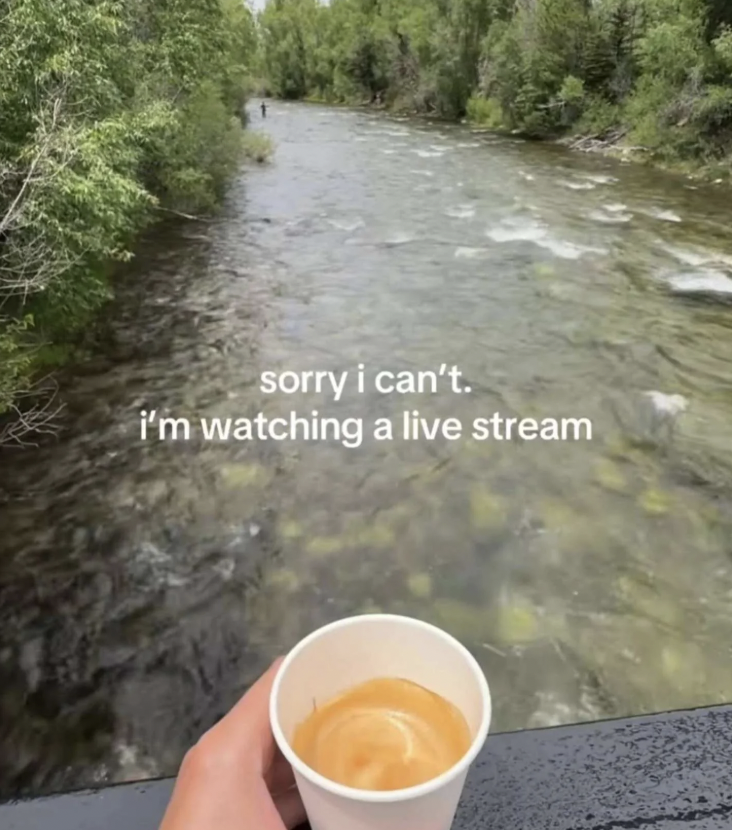
The constant updating and circulation of aesthetic codes and -cores, status symbols and signifiers is profitable for those at the top of the pyramid of value – namely, the social media platform titans which furnish the main infrastructure for image-circulation. For the rest of us, it is sheerly exhausting. What happens to memory and experience when we are so inundated? How long can we go on like this?
Our social media environment creates a peculiar sense of derealization vis-a-vis the offline world, ironically obfuscating the very real ecological toll of always-on computing. And as cultural critic and founder of New Models Carly Busta has observed, the tightening feedback loops between attention, cultural production, and monetization afforded by social media platforms have given rise to a sense of flatness and disconnection. Certainly since the pandemic, when phrases like “screen fatigue” entered common parlance, there has been a palpable desire for something beyond the attention economy, from “techlash” to simply touching grass.
In short, as reactions against the “attention economy” mount, there is an urgent need for platforms and spaces that transcend the flatness of the screen and the visual-first logic of the social media feed. If the technology industry intends to make good on its foundational promises of radical innovation and meaningful connection, it must turn in another direction. Could the creation of more embodied, multisensory experiences be a salient alternative?
To answer this question, let’s embark on a brief history lesson to examine how we arrived at this cultural moment of Peak Visuality. It’s too easy to suggest that our present state of aesthetic saturation started with the advent of the iPhone, released in 2007. Over the nearly 20 years since, social media image-sharing platforms like Instagram have certainly effectuated a major change in our preferred modes of receiving dopamine. But the hyper-emphasis on visuality and aesthetics did not begin with Instagram or Apple; it is a tendency that has been gestating and intensifying since the onset of modernity.
The privileging of sight in Western culture has been called “ocularcentrism,” its contours traced by intellectual historians like Martin Jay and Hal Foster. The celebration of vision above the other senses – sound, smell, touch – is not, they disclose, an immutable fact of human history. Ancient Greek thinkers like Plato and Aristotle considered sight to be the noblest of the senses, but this tendency properly intensified during the Enlightenment as part of a cultural project of “civilizing” and disciplining the body. Sight was taken to be a clean, appropriately-distanced and masterful way of interfacing with the world as other forms of embodied sensory experience, which came to be considered base and vulgar, were marginalized.
Our ocularcentric culture thus long pre-dates the tech industry. But the advent of the internet has no doubt thrown it into overdrive, and globalization has endowed it with new capacities for extracting profit. The rise of digital networks and social media doubled down on the primacy of the visual as images came to circulate more easily than ever before, enabling trends to spread frictionlessly across the world. The researcher and trend forecaster Toby Shorin describes the primary mode of brand innovation today as one of “aesthetic production: the production of images and their value in society.”
Initially, the rise of social media was cause for optimism. Some, like the German art historian Hito Steyerl, thought that this newly-frictionless infrastructure for image circulation would have a democratizing effect – paralleling the cyber-utopian dream that new network structures would automatically lead to more horizontal relations of power writ large. Sadly, that is not what happened. The utopian future of frictionless global connection was colonized by the onset of the aforementioned “attention economy” rife with behavioral capture, exploitation, and manipulation. As social media platforms grew, misaligned incentives led them to turn against users, in a process that the tech critic Cory Doctorow has termed “enshittification.” Enshittification traps users in feedback loops of hyper-individuated consumer categories guided by recommender algorithms – creating a sense of solipsism that I’m sure anyone who has ever slid into an inadvertent doomscrolling session can relate to. It is now harder than ever to sustain the belief that social media platforms’ main goal is to inspire or connect us.
In parallel with platforms’ collusion and corrosion, the rise of generative AI has driven the marginal cost of aesthetics to nothing — but it has also severed the human experience layer which was once presumed to underlie social media. We can make and circulate fake images faster and cheaper than ever. We can fake it till we make it. We can looksmaxx offline to better resemble our online avatars. But the core kernel of felt experience – the affective center of it all – has been thoroughly hollowed. We have reached Peak Visuality, the culmination of centuries of post-Enlightenment ocularcentric culture collapsing from its own emptiness.
Modal Secures Series B-Funding
Congrats to Modal today on the announcement of their Series-B and $1.1B valuation — building the infrastructure that’s moving AI forward.
To expand adoption among enterprise teams, Modal needed a brand reflecting their product’s quality and transformative potential. Together, we developed an evolved identity and site showcasing their flexibility, scalability, and speed. The new brand has established Modal as the leader in serverless infrastructure, accelerating product adoption, funding, and solidifying their position in the developer ecosystem.
Google Featured in New York Times
Google’s Plan for the Future of Work: Privacy Robots and Balloon Walls
Google’s first office was a cluttered Silicon Valley garage crammed with desks resting on sawhorses.
In 2003, five years after its founding, the company moved into a sprawling campus called the Googleplex. The airy, open offices and whimsical common spaces set a standard for what an innovative workplace was supposed to look like. Over the years, the amenities piled up. The food was free, and so were buses to and from work: Getting to the office, and staying there all day, was easy.
Studio Retreat: Sea Ranch

Without a keen eye, one could almost miss it. A slightly deserted, nevertheless breath-taking community of architecturally cohesive and beautifully inconspicuous cedar abodes. In the words of Joseph Esherick “the ideal kind of building is one you don’t see”.
Over the three days spent together in Sea Ranch, the buildings would often disappear. Cement foundation gone, hard-edged, warm windows invisible, splintering walls melting away, years of work vanished around you into the windswept coastline.
All making way for another space more expansive. A boundlessness to fill with equal parts intuition and structure.
By night we looked to the stars, and by day bags of ice turned long sleeve t-shirts into idiosyncratic rainbows.
Colors chosen carefully, mixing slowly, marrying chance, strategy, and wisdom hard-earned over thirteen years.
“Success = modest improvement consistently done.”
—James Kerr
Will Bundy, Eternal Now

This fall, DOG presents [E16] Compound Wonders—a series of four live music events focused on our collective relationship to sound, featuring performances from artists exploring acoustic folk, ambient soundscapes, jazzy ensembles, and analog electronica.
For our third night of the series on November 2, we reached out to Will Bundy, co-founder and director of Eternal Now, to curate the evening.
Eternal Now is a book shop, record shop, ar(k)chive, and communal space for the arts located in Oakland, California. The shop sells physical media and artwork, and hosts concerts, conversations, visual art events and other happenings — both inside the shop and out. Eternal Now also houses a growing archive of art publications, music and ephemera available as a resource to their collaborators.
Over its first year-plus, the space has hosted performances and collaborations with artists like Lonnie Holley, Kehlani, Colloboh, Kesh, Tracy Ren, Nkiruka Oparah, Ovrkast, Zekarias Thompson, Matt Robidoux and many more.
Ahead of Saturday’s performance, the Landscape team invited Bundy to talk about his local cultural influences, bridging intersecting communities, and what lies ahead for the future of the Bay Area creative scene.
Carly Shatzkin, Mindbloom

Mental health can make a positive difference in every part of life—when our mind is at ease, we’re free to live in the moment. But, without the right tools, a healthy state of mind can feel far out of reach.
Mindbloom is leading the next generation of mental health care with ketamine therapy. Centered in science, Mindbloom’s program not only treats the symptoms of pain, but stops it at the source.
See the full case study here
Chris Kallmyer, Artist
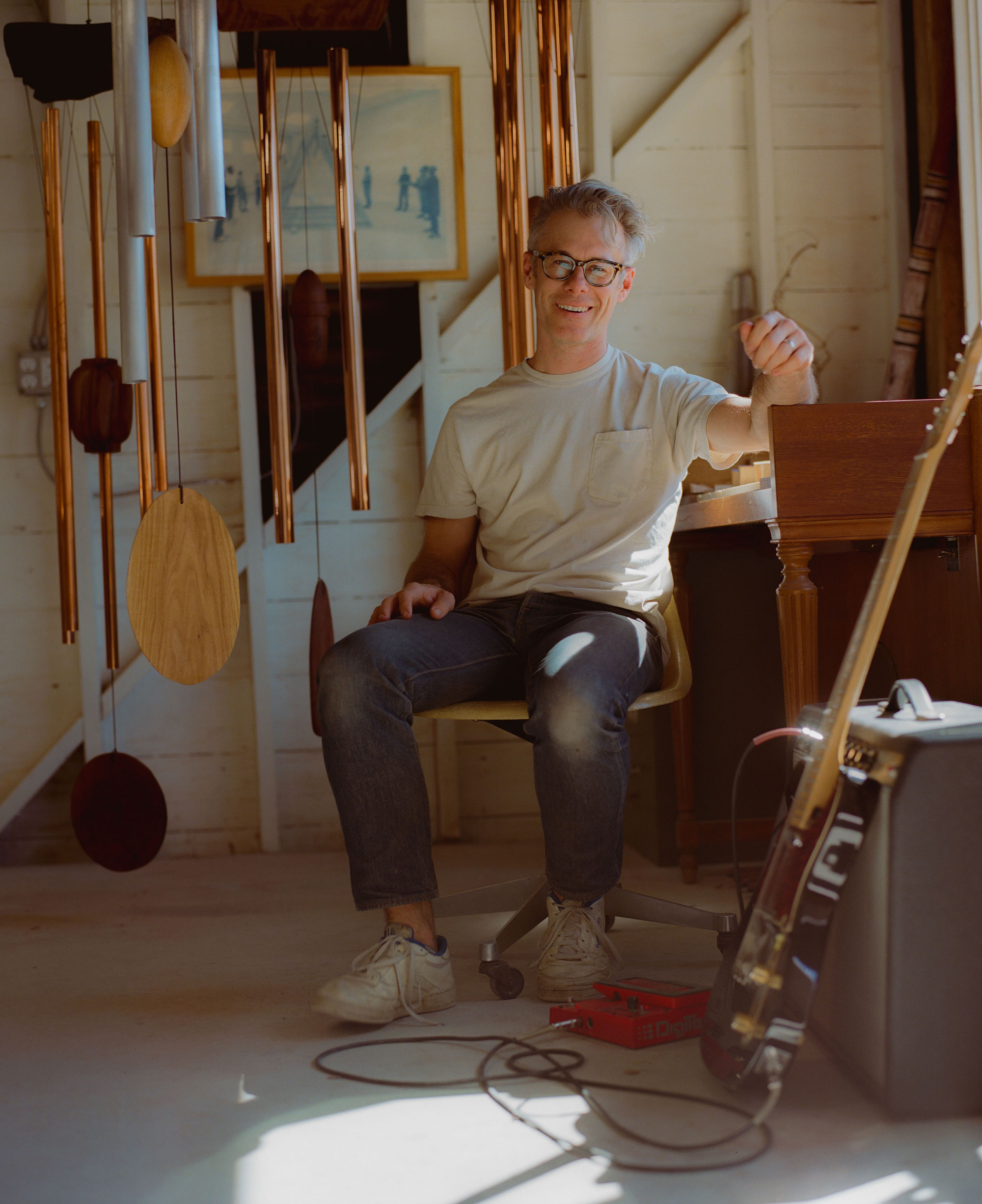
This October, DOG presents [E16] Compound Wonders—a series of four live music events focused on our collective relationship to sound, featuring performances from artists exploring acoustic folk, ambient soundscapes, jazzy ensembles, and analog electronica.
On October 26, our second night of the series, we are excited to welcome Chris Kallmyer—a musician who works in art and design. In 2021 he started Furniture Music, a studio that creates sounding home goods and research-based projects for active listeners, architectural applications, and to promote social well-being through sound.
His installations, performances, and publications have been presented at the San Francisco Museum of Modern Art, Walker Art Center, Pulitzer Arts Foundation, San Francisco Symphony, Los Angeles Philharmonic, STUDIO TeatrGaleria in Warsaw, Fondation Richard in Paris, and the National Gallery of Singapore among other spaces in America and Europe.
Landscape Creative Director Ben Bloom sat down with Kallmyer to talk about his work, the connections between object and sound, and cultivating well-being through listening.
Sahra Jajarmikhayat, Artist

In June, DOG presented SHELTER 750 – a solo exhibition of work spanning design, objects, and sculpture. The show represented a visual essay drawing on an extended index of generative forms, digital aggregates, and algorithmic bodies modeled from volcanic data, frozen in time, then realized into material configurations by artist Sahra Jajarmikhayat over the course of two years.
Jajarmikhayat’s work is hard to define, a photographer by trade but an artist through experiment —unlike most artists, she comes from a rigorous background in research and physics. At 19 years old, amidst a tense political climate, she left Iran and immigrated to Italy where she started a career in photography, giving her a newfound way to record, index, and make meaning of the world.
Leading up to the show, Landscape Creative Director Ben Bloom sat down with Jajarmikhayat to talk about her life and her work, digging into the inspiration behind SHELTER 750 — an out-of-body experience at the Stromboli Volcano — and her unique process of experimentation through materiality and form.
Lisa Chatham, Cookma

Lisa created Cookma based on a deep interest in Ayurvedic medicine sparked during a transformative trip to Kottayam, India. In a Western culture that rarely recognizes the importance of caring for birth-parents after childbirth, Lisa created a brand to bridge a crucial gap in the parenting experience.
Landscape worked closely with Lisa to develop a warm, uplifting and highly differentiated brand identity and experience that captures her desire to provide holistic nutrition to families during this foundational time in life.
See the full case study here
Bold Ideas, Real Solutions – Terner Labs Brand Evolution

Terner Labs was created in 2021 as a sister organization of Terner Center for Housing Innovation at UC Berkeley to help scale real-world solutions to our country’s most pressing housing challenges. From scaling start-ups to building data-driven tools and modernizing construction methods, their unique initiatives bridge the gap between entrepreneurs, communities, investors, and policymakers, informing better future research and policies.
We partnered with Terner Labs to evolve a brand identity and digital presence signaling their critical contributions to housing innovation and leadership at the intersection of equity, affordability, and sustainability.
The new visual system includes a symbol constructed on a modular grid, creating a bold and iconic brand mark that conveys their proactive approach, balanced with a color palette evoking energetic warmth and humanity.
Visit ternerlabs.org
“Heading into 2024, we wanted to evolve our brand to better signal our position and capabilities. Working with the team at Landscape has been great, as they guided us toward a clarified promise, organizational purpose, and bold ways to signal what our organization can bring to the world.”
— Michelle Boyd, Chief Strategy Officer
Baldface, BC

When Jake Burton passed away in 2019, I relistened to his How I Built This podcast episode with Guy Raz. In which he says something to the effect of, “You could walk out the door and get hit by a bus tomorrow, so you better fucking do the shit you want to do today,” in a calm, raspy voice. And to his words, he stayed true. In a small tribute at the time, I wrote how I owe my world to Jake, and the events in my life that inextricably revolve around the sport that he envisioned, nurtured, and pursued. Today, I still feel the same. My daughters, who are three and six years old, both still love to sleep in the white sleeping bag that he handed me and 150 other employees one holiday season in the South 80.
Transworld Snowboarding introduced me to expressive graphic design. I applied for an internship with zero design experience while in college. I was denied. I’ve spent the past two years on trips to Baldface surrounded by old, dear friends from the first design job I eventually did get, at Burton Snowboards. These are the people who drove me, windows open, metal blaring and speakers rattling, to ice-cold swimming holes in the Vermont backwoods in an attempt to convince me to move East. I smiled, let the wind wash over me, and I haven’t forgotten it since. I don’t think I needed to be convinced, but I’m glad they left nothing to chance.
I woke up fully clothed on top of the flannel sheets of my hotel bed that first trip to Vermont. When my alarm goes off at the Lodge, I feel like I’m waking up there again, still surrounded by sleep deprived, blurry, psychedelically slanted and flower-infused-electricity—blasting through the dining hall for a week straight into the snow cats with too many snowboards for 12 people. We prefer mostly K2’s now (right Colonna?).
Our list looked like this: an extra Yashica T4 (thanks Blotto), extra CR17345 3V batteries, extra GoPro batteries, coffee, water, beers, “special-tea”, sandwiches, film, cookies, sore legs, charms, massage guns, wet gloves, extra gloves, extra lenses, joints, lighters, probes, shovels, stickers, radios, and nerves.
Jake might have been saying, “You better accept the fucking invite to Baldface Adam, they’re not going to keep inviting you, and you just might learn something.”
For my travelers:
Toby
Dennis
Cory
Simmons
John
Sean
Dave
Midho
Damon
Mike
Trent
Jack
Jon
&
Jake, thank you.
Opportunity Powered by Insight — Future Partners
We worked with Future Partners to create a complete brand evolution—including a new name—worthy of a small but mighty team of industry experts.
As the company has grown over the past 20 years, its look has remained largely the same. Together, we explored a broad range of new names that balance the credibility and creativity Future Partners is known for. When paired with a vibrant brand identity and sophisticated digital experience, Future Partners signals a clear nod to the future of travel.
Bright in color and bold in typography, the design system is anchored in iconic data visualizations and warm photography that inform and inspire an audience of global leaders. The symbol, which evokes partnership and a gateway toward new opportunities, was constructed to celebrate the endless opportunities that accompany travel.
The digital experience is brought to life by rich stories of client success across the country. Architected to accommodate an expansive library of research, the new website offers an immersive display of the expertise found at Future Partners.
The result is a robust yet flexible system designed to capture hearts, minds, and market share for years to come.
Full case study to come.
Lightning Ridge, Australia
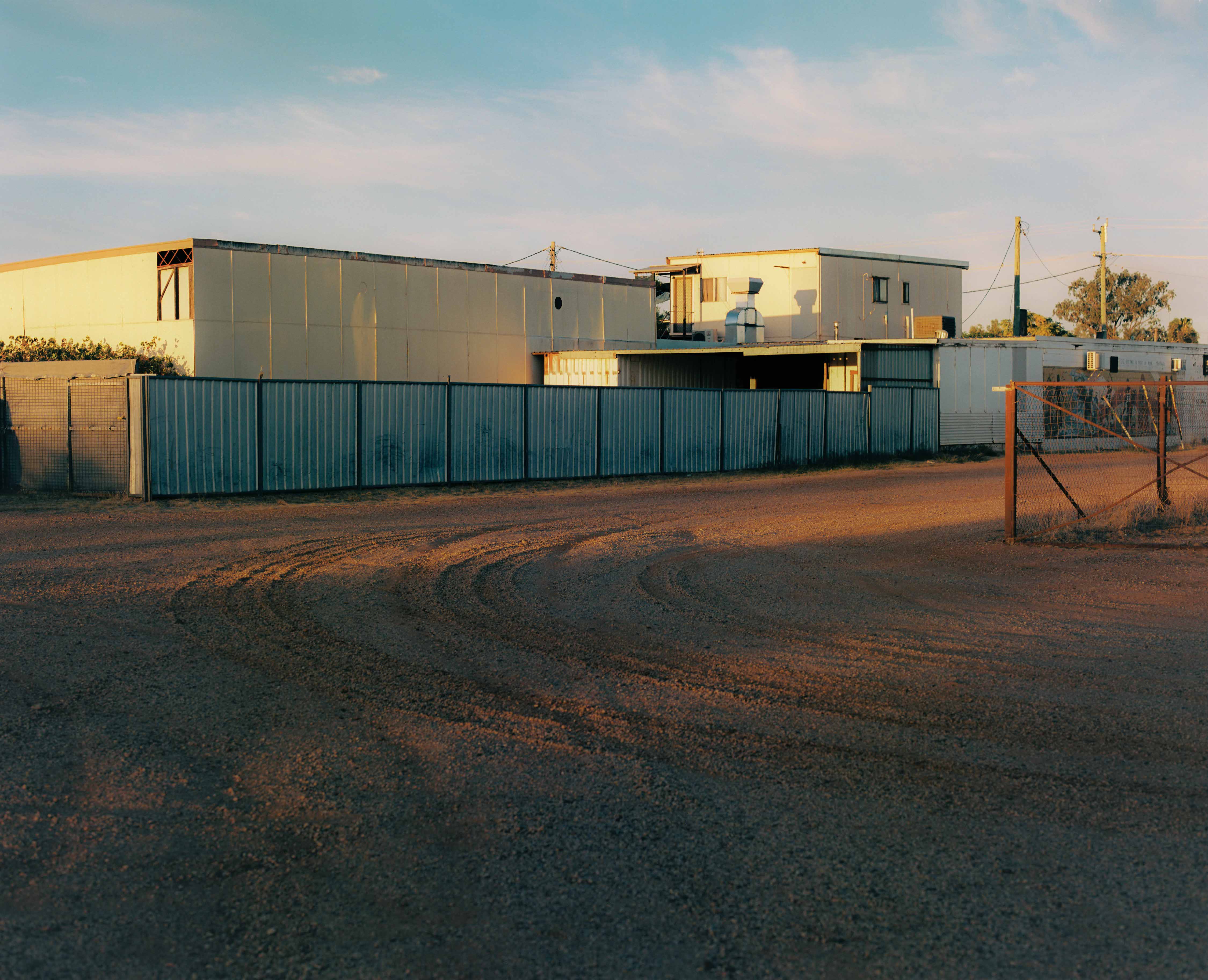
Images and Text by Creative Director Ben Bloom
Once an opal mining hub, now a slightly forgotten but nevertheless eccentric part of the Australian Outback.
The town sits nine hours from any large body of water. Besides a communal hot spring reminiscent of a pre-war bath house with an Australian twist, the landscape is dry; brown and gray as far as the eye can see, occasionally interrupted by a hot burst of Bougainvillea’s.
Our motel was somewhere between kitschy and creepy, a series of single story log cabins with a pub in the middle that seemed to host the majority of the town each night. Most people were friendly, some were not. But ignorance is bliss and I was ignorant.
With most of my time spent steps from the ocean, there’s something about the uninhabitable disposition of the desert that feels magnetizing. Maybe a sense of transient depersonalization, rumbling down a gravel road on the 1200 Sportster, flanked by a terrified emu and a pack of wild horses.
The rest of the world seems to fall away and all you can think about is whether or not your sweaty hands might slip off the grips on one of those potholes and send you into the next dream.
↳ This story is part of an ongoing series featuring stories, images, discoveries, and insights from the team at Landscape. Find more on our News Page.
Taking Humanity Off-Planet: Exploring Design and Branding’s Vital Role

Seeing Is Doing – Albedo Brand Evolution

Seeing is Doing.
Space isn’t just a place to explore. It’s a vantage point for humanity to better understand—and act on the big problems here on Earth.
Albedo is the first company to offer aerial-quality imagery from space, helping people see with clarity and act with certainty. On track for the 2025 launch of its first satellite constellation into VLEO (Very Low Earth Orbit), we partnered with their team to launch an evolved brand and website into the world.
Inspired by the vital perspective on critical details, our landing page highlights Albedo’s exquisite imaging capabilities and the innovation it will bring across sectors, from agriculture and the supply chain to sustainability, security–and beyond.
The site, designed to be as informative as it is inspiring, features custom content, from animations of their satellite to photography showcasing the team at their Denver HQ.
We created a new visual system, including an evolved wordmark that reflects Albedo’s ambition, optimism, and speed, and stands out in the increasingly cluttered and competitive “new space”.
For now, we’re following along Albedo’s countdown to 2025 and are looking forward (and upward) to seeing their new brand in orbit soon.
“In Landscape, we found a creative and strategic partner who quickly grasped the complexities of our booming ecosystem and translated our vision and capability into a compelling advantage.”
— Topher Haddad, Co-Founder & CEO
Aeir

A Vision for Universal Luxury
Founded by the designers behind category-shifting products like Tesla and YEEZY, Aeir is a modern luxury brand that creates universal tools for sensory exploration. We partnered with Aeir to build a striking digital experience introducing the future of fragrance to the world (rolling out over the coming months).
Inspired by the Earth and committed to protecting it, Aeir’s premium subscription service is bioengineered to evoke natural scents without extracting valuable resources. So, as one might expect, we traveled to Joshua Tree National Park to immerse ourselves in the colors, textures, and sounds that shaped the story of Aeir.
During our visit, we worked together to architect a digital experience expansive enough to support the brand’s fast-growing collection and ambitious vision for a Web3-activated business model. Informed by the codes of luxury, a teaser to the new experience launched alongside Aeir’s limited release of bespoke molecular scents.
We look forward to following along as Aeir’s essential system unfolds.
11 Year Studio Retreat @ Whidbey Island

11 Year Studio Retreat @ Whidbey Island
Lindsay Dygert, Client Director

Lindsay Dygert — Client Director
Welcome Cameron

Cameron Kono — Designer
Forward Moves for a Brighter Future

Forward moves for a brighter future.
The Slé app brings transparency and connectivity to your personal mobility patterns—improving sustainability, urban liveability and human health on a global scale.
Landscape collaborated with the team at Slé to shape their brand identity, mobile app, and web experience. With trip monitoring, actionable guidance, and community connection, Slé enables intentional moves towards cleaner air, less traffic, and a healthier you.
Learn more at movewithsle.com and join their mailing list for updates.
We’re looking forward to seeing the full experience launch this Fall.
Full case study to come.
Sharebite featured in TechCrunch

Sharebite, a startup that partners with restaurants to deliver food to corporate clients, today announced that it raised $39 million in a Series B round led by Prosus with participation from Fiserv, Contour Venture Partners, Reign Ventures, London Technology Club and Not Boring Fund. Co-founder and CEO Dilip Rao tells TechCrunch that the proceeds will be put toward expanding Sharebite’s market share, launching new products and developing AI-powered tools to “enhance the meal-ordering experience.”
Rao and Mohsin Memon, Sharebite’s other co-founder, were inspired to launch the company in 2015 after spending years working at Wall Street firms. Mohsin was an analyst at Bank of America, while Rao finished a tenure at Goldman Sachs to join Credit Suisse as an investment banker.
Vicarious featured in TechCrunch

Alphabet X-birthed Intrinsic made its big debut last September. The subsidiary looks to buck its parent company’s somewhat spotty robotics record with a software-first approach. Specifically, the company is looking to make manufacturing robots more intelligent — a concept that no doubt excites many in the space amid pandemic-fueled demand for automation.
Today it made its second big piece of news: an acquisition. Intrinsic is acquiring fellow AI/robotic intelligence firm Vicarious. The Bay Area-based firm has been kicking for a dozen or so years, raising a healthy $250 million in that time from big names like Jeff Bezos, Elon Musk, Mark Zuckerberg and Samsung. The company describes its tech as, “a turnkey robotics solutions integrator using AI to automate tasks too complex and versatile for traditional automation.” That includes standard warehouse and logistics tasks like palletizing, picking and packing.
San Francisco Design Week 2022
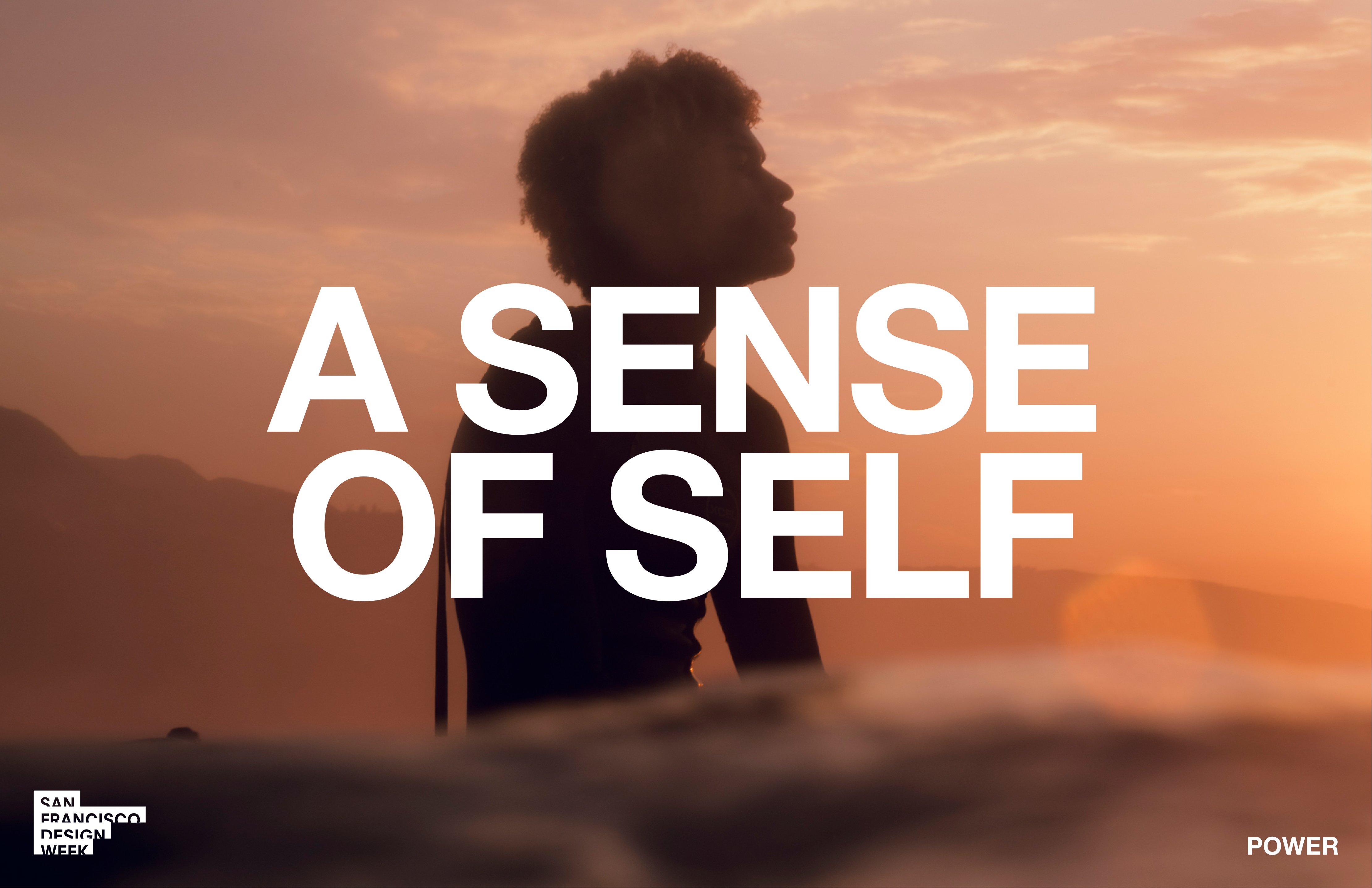
Dialogue, proximity, interface, objects, environment, community — whether physical or digital, any exchange can bring opportunity. In these moments of interaction, we can deepen our understanding, expand our perspective, and advance our practice.
- How can design facilitate connection?
- How might our practices overlap with one another to create shared value?
- What exchanges inspire your work?
- How does the past interact with the present?
- What defines the separation between tool and material?
- How do you create community in response to new and distributed ways of working?
San Francisco Design Week acts as a platform to exchange ideas in service of a better world. This year, the event brings together a global community of designers, strategists, artists, and activists at the edge of connections yet to be made.
10 Years in 250 Pages

In celebration of Landscape’s 10 year anniversary, we’ve captured 10 years of memories and lessons from our team in a 250 page book. Printed and bound locally, it is available for purchase now.
Good & Common in the News
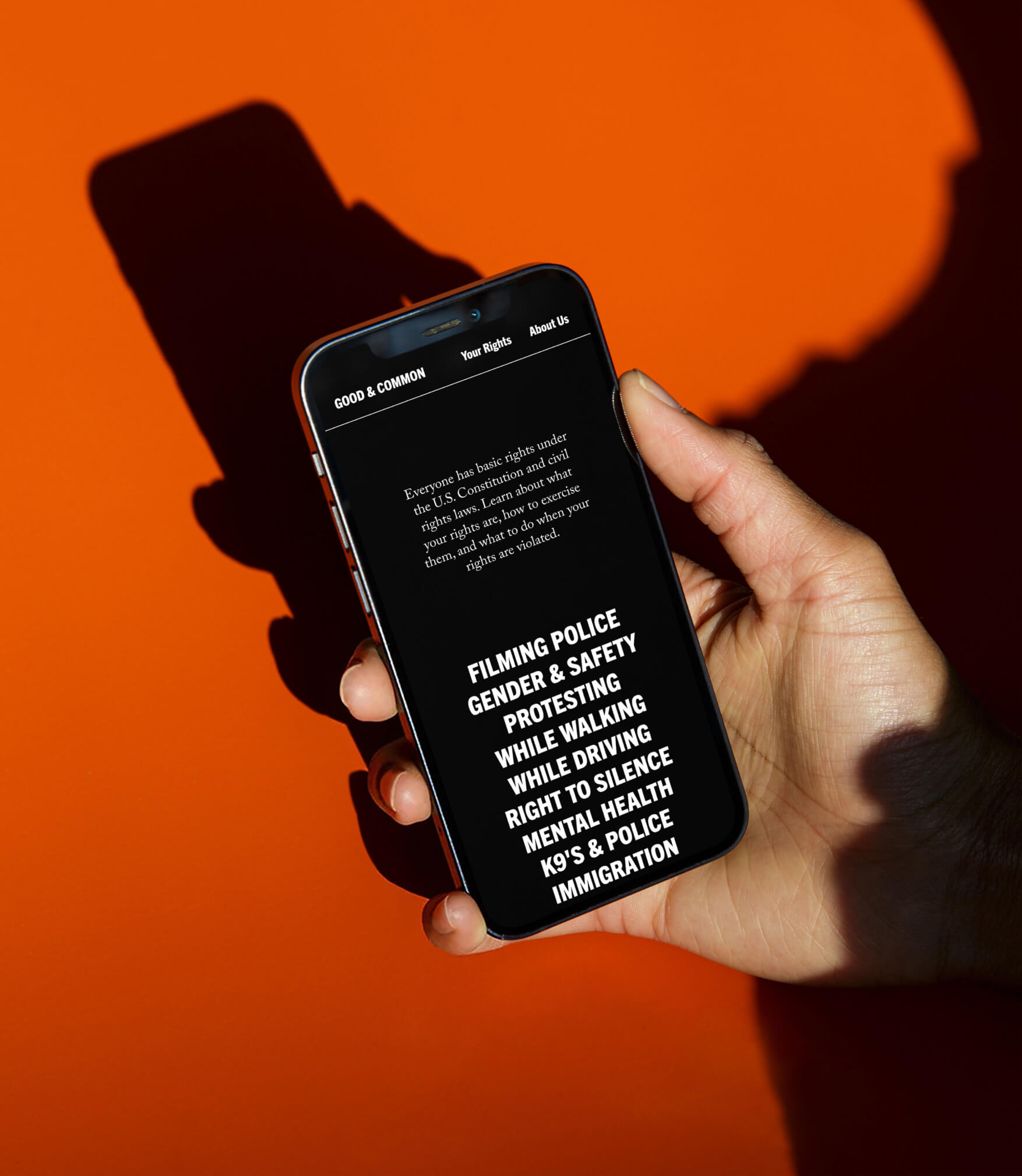
We’re excited to share Good & Common, an online platform dedicated to helping people learn more about their civil rights. Recently featured on PRINT, Creative Boom, and World Brand Design Society.
PRINT
Good & Common is Making Civil Rights Education More Accessible
View Article
Creative Boom
Online Social Justice Platform Uses Designs Inspired by the Civil Rights Movement
View Article
Design Week
The Design of Civil Rights Platform Good & Common Is Inspired by Classic Protest Imagery
View Article
World Brand Design Society
Landscape Partners with Civil Rights Attorney Dewitt Lacy to Design Civil Rights Education Platform
View Article
See Our Case Study
View
Meeting the New Meats

As supermarkets stock their shelves with veggie burgers, chickenless nuggets, and pseudo sausages, we found ourselves wondering how the imitations stack up against the real deal. To find out, our team taste-tested nearly 30 of the alternative protein industry’s favorite brands—all in one afternoon.
Google VISD Summit 2022

We were honored to be a part of Google’s Annual Visual Design Summit. Moreover, we’re excited to see companies with Google’s level of influence begin to leverage design to explore and support the varied needs of an inherently diverse world.
Founder Adam Weiss spoke about where the studio finds energy in a world facing increasingly complex challenges and how the studio crafts narratives to bridge creative exploration and fundamental services.
Learn more about Google’s investment in design on It’s Nice That.
More about this event soon.
From the Windy City
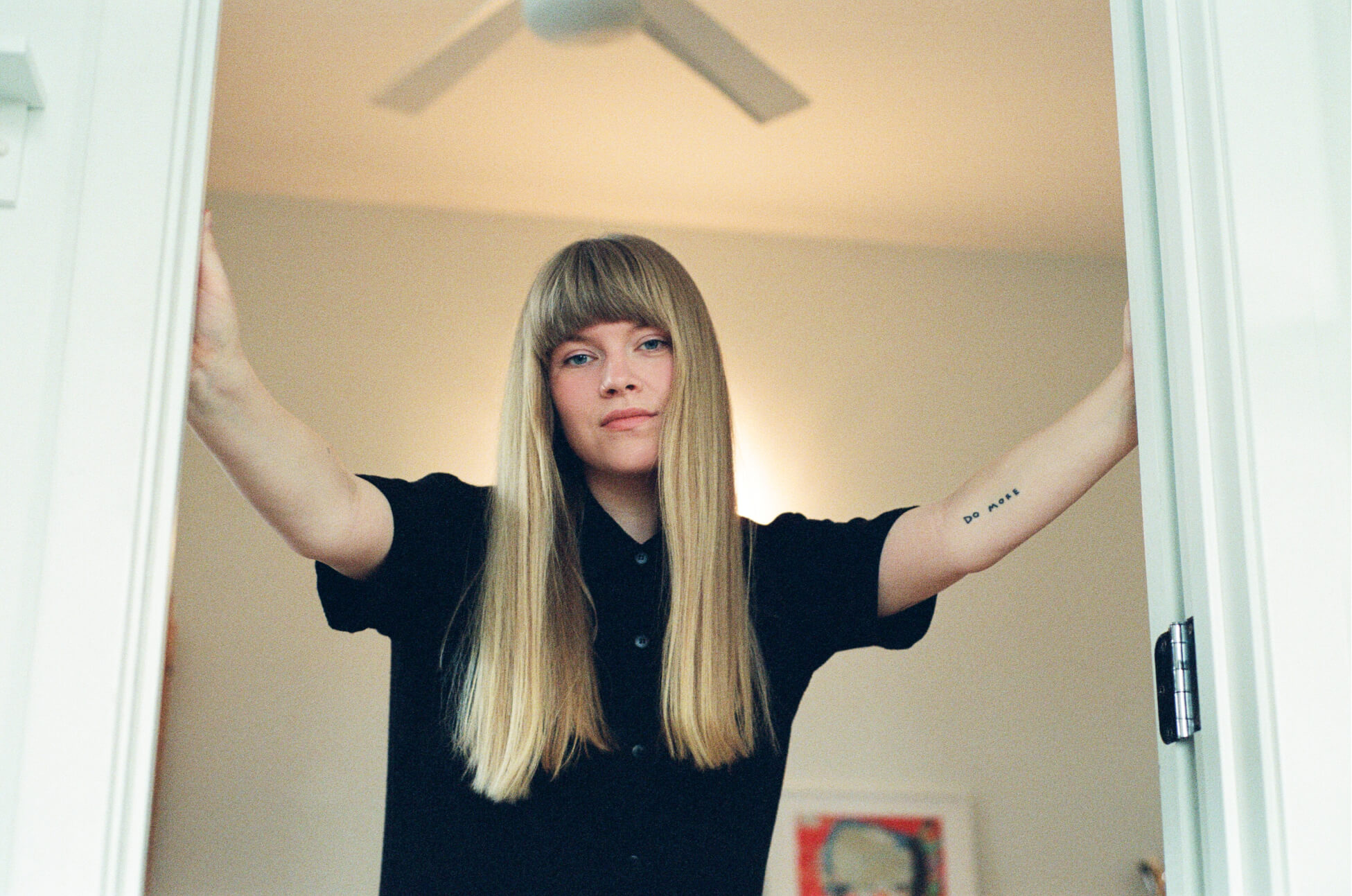
Beth Vande Griend — Designer
Born in Oregon, raised in Iowa, and based in Chicago, Beth Vande Griend joins the Landscape team as a designer. Her approach is framed by intention and understanding—whether shaping identities or architecting digital experiences.
After studying graphic design and art history, Beth spent two years building her own design practice in support of women-owned businesses. Later, Beth led design and social media at Grip, an international creative agency. Her experience spans a range of industries and is shaped by clients like Telfar, TENFOUR, Hanahana Beauty, Shapack Partners, DePaul University, Tao Hospitality Group, CBRE, and Greystar.
In the spirit of collaboration, Beth spends her free time operating a digital creative community and an independent publishing studio. She also enjoys learning about public transportation, collecting screenshots, and exploring the city alongside her dog, Oatmeal.
Shapes of Power with Homan Rajai and Elena Dendiberia of Studio AHEAD
A discussion with Studio AHEAD, a vernacular-bending interior design collective led by founders Homan Rajai and Elena Dendiberia. The Bay Area-based team has a clear vision: to embrace interior design as an untapped platform for local Northern California artists and maker collaboration, not as theatre but rather, an organic expression of heritage in all forms. Homan and Elena embrace their blend of Persian and Russian heritage with time abroad in Kenya and Mexico to formulate a multicultural approach to design in San Francisco. Their enlightened philosophy is cemented in their collective desire to respect the many aspects of the region’s diversity through thoughtful, custom design.
Shapes of Power is a series of discussions hosted by Landscape, a boutique brand strategy and design studio shaping structure and surface in service of social good. In candid conversation with some of the studio’s most inspiring clients and collaborators, the program is an opportunity to explore how power manifests across a variety of disciplines.
In partnership with San Francisco Design Week.
Moderated by Adam Weiss, Founder and Creative Director at Landscape.
Shapes of Power with Shirzad Chamine of Positive Intelligence
A discussion with Shirzad Chamine, Founder and CEO of Positive Intelligence, the foundational mental fitness platform based on the science of positivity. Outside of the core six-week program, Positive Intelligence has come to life through a New York Times bestselling book and a comprehensive course at Stanford. Shirzad believes that the mind is your best friend, but it can also be your worst enemy. The program is designed to help you shift the balance of power in your brain by better understanding your thoughts and behaviors.
Shapes of Power is a series of discussions hosted by Landscape, a boutique brand strategy and design studio shaping structure and surface in service of social good. In candid conversation with some of the studio’s most inspiring clients and collaborators, the program is an opportunity to explore how power manifests across a variety of disciplines.
In partnership with San Francisco Design Week.
Moderated by Adam Weiss, Founder and Creative Director at Landscape.
Seed.com Wins Site of the Day on Awwwards
Cosmic Picnic: Visions
People. Illuminations. Visions.
Shot on location in West Marin for local home goods store Visions, Cosmic Picnic is a summer campaign that reflects the sensibilities of a community of artists, musicians, and thinkers.
The store is home to an assortment of local offerings and acts as a hub for music, food, and art. Connecting people with place and objects with moments, the campaign is a surreal glimpse into a summer day on the California coast.
New Client — Sharebite
New Client — Twic
Shapes of Power with DeWitt Lacy of Good & Common
A discussion with DeWitt Lacy, Founder of Good & Common, a community resource dedicated to democratizing civil rights education and providing accessible tools for advocacy. With a decade of experience in civil law, DeWitt focuses his efforts on police misconduct and brutality. He began working on Good & Common with a simple goal: to increase public awareness of essential human rights. The platform provides critical information to support self-advocacy in potentially dangerous and life-threatening situations. With the intent to grow the brand across the nation, DeWitt hopes to engage with supportive partners, educational institutions, and diverse communities.
Fast Co: Tastemaking for Tomorrow
Feeding a planet of 10B people sustainably isn’t going to be easy. But, new protein alternatives will make it possible.
We recently shared our thoughts on emerging brand strategies and stories with our friends at Fast Company. Read the long form version of our article below.
A Cross-Country Connection
Dana Kingery — Designer
Meet Dana Kingery, the latest addition to our team.
Dana is a designer and illustrator with a love for learning. Her artful nature is complemented by a research-oriented practice that considers unexpected connections between otherwise unrelated things. In doing so, she is able to craft unique narratives that reflect shared human experiences.
Before joining Landscape, Dana’s career led her across the country. She began in Denver alongside the team at Studio Mast, where she collaborated with Mackey Saturday to shape visual identities for local and global brands. Next, she found a home in Nashville with Perky Bros. There, she guided projects through a holistic creative process and discovered a talent for meticulously drawn maps. She has since worked with a variety of clients, including Patagonia, El Paso Opera, Klarna, FutureNow, Andrew Zimmern, and Forgotten Boardwalk.
Dana grew up on a farm in Minnesota and quickly fell in love with the outdoors. Lately, her favorite way to experience the world around her is by way of her bike. At home, she can often be found trying new recipes, watching movies, and experimenting with her iPad—all in the company of her cat, June.
Shapes of Power with Micaela Connery of The Kelsey
A discussion with Micaela Connery, Co-Founder of The Kelsey, a non-profit that centers on the lived experience of people with disabilities and the creation of inclusive and affordable multifamily housing.
Garnering the attention and support of organizations like Google and the Chan Zuckerberg Initiative, The Kelsey is currently advancing a housing pipeline worth over $180 million—beginning with more than 240 affordable, accessible homes in one of the nation’s most challenging housing markets, California.
Inspired by her cousin and Co-Founder Kelsey, Micaela started The Kelsey to bring a disability-forward mindset to everyday practices of housing design, in development and operations. In partnership with community leaders, investors, developers, and policymakers, the team has created a nationally scalable blueprint for success.
Curative Featured in PRINT
COVID-19 is something we’ll be talking about for years to come. We’ll forever remember the times and places that we spent in the world before COVID drastically took the world by storm. We’ll pass our quarantine stories down to our children and our children’s children. It is and was a time of solitude, but also a time where so many great moments of togetherness, innovation, and creativity had the chance to shine through and take center stage.
Established by Fred Turner, Isaac Turner, and Vlad Slepnev in January 2020, Curative was first designed to develop a new sepsis test. However, when the pandemic intensified in March 2020, the team decided to produce a quickly scalable COVID-19 testing process to help flatten the curve and save lives.
Since implementing the scalable COVID-19 testing process, Curative has been working with communities across the United States to fulfill testing through turn-key programs, streamlined patient experiences, and scalable infrastructure to make health services simpler to access for everyone.
New Client — Journ
Postcards From Everywhere
Postcards From Everywhere
Spring / Summer 2021
A Kind of Guise reached out to our Creative Director Ben Bloom to collaborate on an editorial photoshoot promoting their latest collection. Due to pandemic related travel restrictions, the campaign took on an entirely new format: photographers from around the world were given a camera, two rolls of film, and a few outfits. The rest was up to them.
Shot in Raglan, a small town along the coast of New Zealand, and Ben’s part-time home, the photos capture the candid moments and everyday lifestyle of a small surf town down under. Featuring a few of his closest friends, the community is an eclectic mix of surfers, artists, makers, and musicians.
New Client — BlueUmbrella
A Warm Welcome
Alison Yousefi — Designer
We’re thrilled to introduce Alison Yousefi, the latest addition to our team.
Based in San Francisco, Alison is a thoughtful designer with a knack for building systems and stories that stick. With a background in printmaking and photography, her practice is rooted in hands-on experimentation.
After graduating from Occidental College with a degree in visual arts, Alison led the editorial efforts of WhoWhatWear, an international fashion company. She later joined the team at Dropbox, where she developed a pragmatic approach to artistic expression. With a keen interest in all things analogue, Alison believes that play is an essential part of the creative process.
A casual surfer and artful maker, Alison enjoys digging through Craigslist ads and taking photos with her trusty Contax 139 Quartz. Between shots, she can be found giving new life to abandoned furniture or petting other people’s dogs.
Shapes of Power with Yuji Sakuma of Seed
A discussion with Yuji Sakuma, Design Director at Seed, a microbial sciences company exploring the vast potential of how we live and care for ourselves, our children, and our environment.
From experimental and sustainable packaging to engaging educational content, Seed’s brand lives at the intersection of science and design—a progressive aesthetic backed by intensive research.
Alongside Founder Ara Katz, Sakuma spearheads the visual touchpoints of both Seed and its parent organization, Seed Health. Looking forward, Seed hopes to enable the next generation of probiotics and microbiome-based innovations that will forever change the global categories of health, hygiene, diet, and self-care.
Landscape Hosts: Shapes of Power
In candid conversation with some of the studio’s most inspiring clients and collaborators, this series explores how power manifests across a variety of disciplines.
In partnership with San Francisco Design Week.
Moderated by Adam Weiss, Founder and Creative Director at Landscape.
Seed Health Raises $40M Series A
We’re thrilled to see our client Seed announce their $40m Series A this month. We partnered with their team to evolve their brand via redesigns of both Seed.com and Seedhealth.com.
A collaborative effort to shepherd the brand from niche darling to multi-world pioneer.
Put best by Co-CEO & Co-Founder Ara Katz:
Do it big.
Do it quiet.
Make it mean something.
•
We work in the world you cannot see,
yet cannot live without.
In a year when the invisible has never been so visible and confirmed the urgency to rethink everything, I feel privileged to do what we do.
For humans,
For honey bees,
For coral reefs,
and beyond.
All because
of our extraordinary ecosystem
of Superorganisms
who wake up each day
to nudge the world
forward.
Read the full press release for more.
PR Newswire
From Ohio with Love
Marie LaLonde — Copywriter & Strategist
Marie LaLonde is a copywriter, strategist, and morning person living in San Francisco. Formally trained in graphic design, she quickly discovered words to be her preferred medium of expression. Both a visual thinker and engaging storyteller, Marie is a multi-hyphenate whose work explores the circular relationship between language and form. Her experimental practice is grounded in clarity, purpose, and empathy.
Before joining Landscape, Marie collaborated with the design team at Apple to conceptualize and execute global campaigns, environments, and experiences. Always an optimist, she believes in smart solutions at every scale.
When she isn’t in the studio, Marie enjoys volunteering with kids, studying anthropology, and caring for her ever-growing collection of plants.
San Francisco Design Week 2021
Power is everywhere.
It’s local and global, personal and public, selfish and selfless.
There is power in the food we eat, the music we make, and the ideas we share.
Power is a seat at the table, a path forward, and a new beginning.
Rule of Three featured by the Dieline, World Brand Design Society, and more…
In the Age of Authenticity…
Original article by Jess Zafarris — Oct. 16, 2020
Adweek interviewed Landscape Founder & Exec. Creative Director Adam Weiss alongside other global branding experts including design world icon, educator, and author Debbie Millman as well as Robyn Kanner, senior creative advisor for the Biden campaign.
Landscape is endorsing Joe Biden and it has nothing to do with his branding.
Political design systems can act as tools to multiply and expedite the dissemination of messaging and build affinity (if not trust or credibility). People love sports because everyone loves to win and the scores and rules are clear. In politics today the opposite is true, there appears to be very few rules, and so something like a Bernie shirt or MAGA hat offer a semblance of clarity, the opportunity to bet on something simple — like ‘Hope’ during Obama’s era.
I think the ‘hope’ this year would be that voters recognize the need to dig a bit deeper and not only find a slogan they can understand, but find out what is true. Who will act honorably in a time when our nation faces horrific obstacles and great suffering?
The candidates in recent elections have been very clear embodiments of their own brands. Their individual stories and signals, very distinct.
- The First Black President
- The First Potential Woman President
- A Political Outsider Business Person
- A Step Towards Reason During Time of Unrest
Everyone reading these words has a distinct, unique image leap to mind. While each candidate’s design systems can help to address their potential shortcomings or reinforce their strengths, likely, audiences are not splitting mediocre typographic hairs — they are trying to understand the game.
This year we’re asking questions like: Who would you leave alone in a room with your children? Who will put their candidacy before my health? Is the life of an unborn child more valuable than the lives of seniors being killed by COVID-19? What does it mean to hold life and duty sacred? Do I care if this person is a racist?
Landscape is Endorsing Joe Biden
Landscape is led by the belief that experiences can continuously be improved upon, shared more equitably, and explored more deeply through thoughtful participation. Participation can take many forms: design work, personal relationships, what we buy, where we buy it from, etc…
In 35 days we’ll participate in improving our country by voting.
In a nation where people are suffering horrifically and unnecessarily, our actions have never been more important.
Landscape is endorsing Joe Biden.
There are innumerable reasons, but quite simply, because he represents unification over division, honesty over deception, and love over hate.
New Client — Seed
We’re exploring brand and digital with Seed as they explore the potential of bacteria for human and environmental health.
New Client — Lisa Chatham
Designer Fund Feature
Designer Fund invests in design led tech startups like Stripe, Gusto, and Omada Health. We’re honored to be featured in their guide to selecting the right creative partner.
“…nearly every startup needs creative help at some point in their lifecycle—often during key inflection points, such as raising funds, up-leveling into a new market, or communicating who they are to the world for the very first time. Freelancers, studios, and agencies can also be more than just an extra pair of hands; they can be strategic thought partners, helping you create work that is core to your business…”
Call for Applications
To play a more active role in creating an inclusive and equitable community, we will be offering free branding and design work to Bay Area Black-owned businesses as well as organizations contributing to the fight against racism, police brutality, and other systems of oppression.
Our goal in offering this work is to leverage our skills in a way that makes direct and ongoing impact in the Black community. The process will be collaborative and we hope that each engagement is the beginning of a relationship, creating more opportunity for open dialogue.
We plan to take on two projects each year. To apply, please tell us about your company or organization, your mission, and what design services we can help you with. We look forward to meeting you!
Additionally, please help us spread the word by sharing this post.
Join Us at San Francisco Design Week
The past days, weeks, and months have demonstrated that things are always changing, and that things still need to change.
We look forward to coming together to exchange ideas and channel our collective energy.
In Solidarity
We stand in solidarity with the Black community, and against systemic racism. We hope that today we’re able to act as a multiplier.
Here’s a list of anti-racism resources, funds, charities, initiatives, and individuals to learn from, donate to, and support.
Ways You Can Help
via blacklivesmatters.carrd.co
Resources Supporting BLM
via itsnicethat.com
Please consider the resources you have in this moment, and join us in donating your attention, time, and money.
We all have work to do.
Throwing the Lasso: A Word on Naming
At its heart, naming is about identity. One way to think about this is as a kind of balance. Like an equation, stability occurs when dynamic expressions are in agreement. Otherwise the equation doesn’t work, it doesn’t prove what it’s supposed to prove. This metaphor is more than an illustration. When pursuing a name, a systematic approach helps us align with our partners to work through the science of building an identity. A great name is built on balance.
No one has trouble naming a pet or a plant, and new parents do not have to clear legal trademarks, or find a suitable, searchable domain for their newborn. But a brand is different. A quality brand name signals different attributes to help it succeed. Each company has its own priorities and needs, but these attributes start with the following territories:
- Category — Does the name indicate what service or product the brand provides?
- Community — Does the name target who the brand is for, the ideal client or customer?
- Culture — Does the name accurately represent the attitude and values for the brand?
- Creativity — Is the name memorable, ownable, and appropriate at scale?
Before starting to brainstorm, identifying these principles helps set parameters around what to explore. Not only does this save time, but it helps generate strong naming directions. Because a name is the most-used element of any brand, the more dots that connect, the stronger a name can be. Clarifying the story, prioritizing values, and identifying opportunities are requirements for creating a valuable identity.
The Right Creative Partners
The biggest difference between choosing a name by yourself or seeking the help of an agency is point of view. A creative partner can share a creative point of view, as well as objective reasoning. They can help you think through the problem, as well as the solution. For example, it can be easy to be overly critical, until all the good options are gone and you’re left with a mediocre name that only stands out for being safe. Usually, it’s easier to see the possibility of risk than the potential for success. Too loud of an inner critic and every name will have something wrong with it. Daring names risk alienation; safe names risk oblivion. And every name risks the bitter landscape of trademark threats. When Apple first explored the iPad, many people were concerned that it sounded like a hygiene product. According to The Atlantic, Apple’s agency didn’t swerve, and once people saw the product their concerns disappeared.
As in any healthy relationship, having the right partner makes or breaks the outcome. Working with the right creative partner means encouraging a diverse scope of solutions, with a safe space to work through concerns, public, and personal. The more a name can stand out (while staying on brand), the more upside it stands to have. After all, fortune favors the bold became a cliché for a reason.
Indistinguishable from Magic
We call it design when we set out to improve an experience. We can also call this strategy. However, the quality of the strategy plays a huge role in determining how lasting and how influential a newly designed experience will be.
Frank, our Director of Strategy, shares his thoughts on brand strategy, walks through our approach, and talks about the fundamental ingredient to great design.
→ To set the scene, what are some examples of brands you look up to for their strategy?
There is a quote from the great SciFi writer, Arthur C. Clarke, “Any sufficiently advanced technology is indistinguishable from magic.” I like to think that any sufficiently excellent brand strategy is invisible, yet intuitable. Brand strategy acts as a foundation for great branding, design, and experiences. I’m really interested in brands that lean into challenge during times of uncertainty, not just reacting with clever campaigns.
Here are some of my favorite organizations doing extraordinary things, based on sharp business strategy and clear brand communications:
- Space X, pushing for new frontiers, balancing the here-and-now promise of reusable rockets with their long-term purpose of making human life interplanetary.
- Airbnb, helping people around the world find a sense of belonging in times of divisiveness and stepping up to provide accommodation for emergency workers in times of crisis.
- Patagonia, on their long journey towards creating a sustainable business and product, inextricably linked to positive environmental action, which should be a goal for any company.
- FC Barcelona (Barça), selling not only great sportsmanship, but turning the universal love for soccer into a force for good around the world.
- Greta Thunberg’s Climate Action, creating a movement that channels the frustrations of a new generation into peer-pressure on politicians — and the rest of adults everywhere.
→ How would you describe Landscape’s approach to strategy?
At Landscape, we craft lasting narratives and experiences for clients who pursue positive change.
In this context, brand strategy serves to identify a company’s evolution opportunities and then charts the best path for the brand to manifest those opportunities via narratives and experiences.
The emphasis for us is on “lasting,” which means that strategy provides both the foundation for and guidance toward the ideal future position for our clients’ brands. And the emphasis on “change” means that our strategy ensures that every element of our work acts as a lever to our clients’ business goals. Strategic thinking is about creating the framework for a long-term vision and charting the journey to get there. While great strategy may address a current trend, it should be able to transcend them on an ongoing basis. Perhaps even more ideally, it should generate new momentum within any given market, helping to drive growth.
→ As a strategist, what challenges do you face the most?
Articulating paradigm-shifting ideas in the right way. Many of our clients are working on scaling emergent technologies and services that don’t yet exist in their form today, whether it’s biology lab automation, AI-powered robotics, VR-Creativity, or social impact measurement.
At the heart of this challenge is the need to craft a simple, compelling story that helps make new experiences both understandable and desirable, enough so, to engage people and drive action. Moreover, the story needs to resonate widely, from the initial commercial customers to investment and industry partners, to the talent needed to grow the company, all the way to the broader public, which needs to be supportive, if not enthusiastic, for the new idea to take hold.
Creating these narratives is one of the most interesting challenges we get to take on, and seeing the stories come to life is very fulfilling.
→ What part does strategy play in the creative design phase?
At Landscape, strategy results from a rigorous partnership between our strategists, designers, writers, and our client partners. We don’t see strategy as a manual for “paint-by-numbers” for designers. Rather than siloed disciplines, we believe good creative strategy is the result of cross-discipline collaboration.
Everyone on the team starts with the same shared intention of charting the ideal path forward, and our designers are just as involved in the discovery phase and holistic formation of strategy as I am. We immerse ourselves in the clients’ business, culture, their customers’ mindsets, and the trends shaping the category ecosystem. This phase yields the positioning opportunities and guiding principles for the brand. We then prototype options for possible brand futures, composed of the relevant visual, verbal, and experiential touchpoints.
→ How does brand strategy connect the brand promise, positioning, and design principles?
We work with our clients to create clarity around where they want their business to go and which values should guide them there. Naturally, language plays a big role in starting and stimulating the process. Together, we explore positioning opportunities and guiding principles based on the true advantages of the brand’s offering. With that as a working setup, we can explore the key elements for the brand platform:
- Why — do we exist as an organization?
- How — do we create ongoing value?
- What — do we offer our customers that’s unique?
“Brand strategy” in this context is not the ultimate deliverable, but the successful process of identifying, articulating, and aligning around key opportunities and charting the path to realize them. How do we know what we think until we write it down? In this process, good writing is a critical tool for exploring new ways of thinking about one’s brand and how those ideas shape perceptions in the world.
→ Can you share any tricks you use to generate or visualize your thinking?
I spent my first ten years as a strategist in a global brand consultancy collecting and creating new brand frameworks and models: onions, pyramids, matrices, nine-ups, and even 3D frameworks from Japan. Eventually, I threw them away. I started simplifying and using more of my experience to start guiding strategy and design work toward what’s needed, when it’s needed. No single framework is suitable for any single situation, which means we often create new ways of framing good thinking together with our clients.
That being said, one of my favorite and most simple tools are Venn diagrams. They’re great for nudging our thinking to be more holistic and inclusive, help us identify those elements that, when convened, create new opportunities for ideas, stories, experiences — or sometimes even a new category. What business models are you converging, what cultural trends can you thread together, what technologies are you integrating in never-before-done ways? But there are many other useful tools and frameworks that we can use or create based on what’s needed.
→ What type of branding does Landscape specialize in?
We don’t specialize in any particular type of brand or industry. From fashion, art, and cultural organizations to new technologies, our client set reflects a curiosity in shaping change, across the spectrum. I think many of our clients seek us out for that capability.
The exposure to visionary people with emergent ideas across all categories allows us to think about the world and its many possible futures more broadly. It helps us to connect the dots, share alternative perspectives from unexpected angles, and find storytelling opportunities that stand out and stand the test of time. It’s very rewarding to help our clients create, shape, and articulate these new ideas at critical moments in their evolution, inception, or scaling — something that we have gotten good and fast at.
Clients don’t come to Landscape for a style; they come for the thinking. They trust that based on the diversity of the work we have done, we can execute bespoke solutions through the lens of a specific business strategy.
→ What’s your advice for brands that are looking to find the right design partner?
- Diversity is the key ingredient to the best and most robust ideas. If you want to stand out, don’t hire a brand partner for the same technical expertise in your business (that’s your job). Hire them for their creative capability. Find the most diverse, talented, curious, empathetic, and holistically-thinking people you can.
- Collaborative energy. Set your team, partner, and process up so that shared optimism, clarity, and urgency can guide you to push beyond the expected together.
- Defining success. The outcome is not just an evolved brand with a couple of hard-working artifacts but also the learning journey that you and your design partner will have completed together.
Interested in learning more?
Say Hello
🌎
A creative strategist known for channeling optimism and clarity for over 19 years, Frank H Vial has worked with many of the world’s best-known brands including Chevron, Electronic Arts, Hyundai, Panasonic, PepsiCo, and Taj Hotels. He has helped to shape and position startups and challenger brands in Europe, Asia-Pacific, and the U.S.
Frank joined Landscape after spending several years consulting with San Francisco’s most innovative design firms and startups, shaping strategy for clients in wearables, gaming, analytics, clean energy, robotics, nutrition, and hyperspeed mobility.
Previously, Frank was Strategy Director at Landor, a leading global brand consultancy.
An endurance runner and proud dad, Frank is interested in good conversations and articulating creative strategies to help shape a better world.
Design Week + Tokyo 2020
“Crisis can breed opportunity”: should Tokyo 2020 rebrand?
Original article by Henry Wong April 7, 2020
As COVID-19 changes the events landscape, with delays to events as big as the Olympics, designers discuss how brands like Tokyo 2020 can adapt – and possibly even thrive.
Design Week interviewed Landscape Founder & Creative Director Adam Weiss alongside other global branding experts. They were asked to consider two questions.
First: Though the ceremony has been postponed until 2021, the International Olympic Committee announced that the Games would keep its name as Olympic and Paralympic Games Tokyo 2020. Is keeping the branding the same the right decision?
› If you’re defining the “branding” as the emblems for the games, then I think enough is changing fast enough in the world as is. The two emblems, which speak to diversity, stability, equality and human connection, honestly couldn’t be more relevant. For many, stability and predictably are hard to find right now.
Moreover, I appreciate that the symbols are complex — this complexity feels more honest to the era that we live in. The world’s current arena is science, who’s complexity (channeling Neil Degrasse Tyson) challenges the perimeter of our understanding on an ongoing basis. Additionally, the interconnected structure of both emblems alludes to the global team-effort to keep our communities safe.
The world has been in need of new — universally positive symbols for a long time. A modern peace sign? A non-corporate, team-oriented swoosh?
Lovely.
Second: As global events like the Olympics are being postponed — and the expensive campaigns invested in them — what are the challenges and opportunities for brands?
› If your product isn’t a necessity you’d better hope your brand is. A scenario to consider: What brands would you actually miss were they to vanish tomorrow. If you couldn’t have their product could it be replaced or duplicated — could the center of gravity shift platforms? I think it’s likely. But if they’re gone — whose story do you miss?
Top of mind:
Whole Earth
Leica
Patagonia
Teenage Engineering
Apple
The New York Times
Samovar
Nike
LOT
A few big expected ones, but these brands stick to their values and challenge us as people to be optimistic about our potential on the other side of challenge. They are delivering the goods and going big on their cultural vision. That is, they are invested deeply in our cultural health. Apple led me to Carl Sagan, and Carl to my current philosophy regarding the importance of design. As COVID-19 solidified its presence in the U.S. Nike asked the world to stay inside on their landing page, a billboard worth god-knows how much, while Adidas tried to sell me Yeezys. Levis, maybe time to digitize your workshops… until you can open them and bring a now-shuttered favorite restaurant back to cater the spaces… Necessity is the mother of invention.
People are paying attention now. They will probably have to start making more choices and they will cut the fat.
There are products I use and appreciate, but their brands, vacant. I spend hours a week on Instagram but what’s their story? What does Twitter stand for? Both should take a page from The New York Times. Sonos is all over my home, but has no space in my heart (as I struggle through the UI while my two-year old clamors for Baby Shark).
Function + vision will rule. How are you helping your customers navigate the most stressful moments of their lives? How do you make life better? I’ll buy what I need — I’ll align with who makes me care.
Read the whole article on Design Week
Radix on siteInspire.com
Community Update
In the interest of the health of our community, the Landscape team will be working from home and engaging with our clients remotely. We would encourage our greater network to limit unnecessary social contact to support those whose lives might be touched by COVID-19 and our hearts go out to those whom already have been.
This past week marked Landscape’s eighth year. As a small, independently owned studio, we are thankful for the trust our clients have placed in our team over the years.
Moreover, we’ve been fortunate to have a window into the hopes our clients have for their vision of the future. It is ambitious, often unexpected, and guided by a need to make the human experience better, and more readily accessible to all.
During these challenging times I personally find some comfort in knowing that there is a strong and wildly capable community of people intent on doing good and opening the aperture of our shared lives together.
Landscape was started in a home. Today, Landscape exists in 10 homes, connected to families and friends in San Francisco, Jakarta, Seattle, Hamburg, Seoul, Los Angeles, Atlanta, and New York.
We will continue to support our community, friends, and clients with the skills and resources that we’ve gathered over the past few lucky years, and hope that you find some shared energy in this spirit. That it guides you towards generosity, love, and hopefully safety.
Warmly,
Adam + Landscape
Vicarious Featured in Wired
At the offices of startup Vicarious in Union City, where the San Francisco Bay Area’s sprawl abuts rolling hills, 10 robot arms tirelessly place travel-sized beauty products into bins on a conveyor belt. Each gray arm ends in a suction-cup-tipped finger that makes a high-pitched whine as it plucks items such as antiperspirant or hand lotion from crowded boxes.
Vicarious buys standard industrial robots, enhances them with its software, and contracts them out the way a temp agency does workers—charging per task completed or at an hourly rate. In Baltimore, Vicarious robots assemble sampler packs for makeup company Sephora, work previously done exclusively by humans. Vicarious CEO and cofounder D. Scott Phoenix says the deal demonstrates his business model: Create artificial intelligence software that makes industrial robots smart enough to perform jobs previously done only by people.
Vicarious hasn’t previously discussed its customers or robots publicly but has earned itself an air of mystery among AI and robot experts since its founding in 2010. The startup has raised more than $130 million, according to data service PitchBook. Its investors include some of Silicon Valley’s most famous names and deepest pockets—venture firm Founders Fund, cofounded by early Facebook investor Peter Thiel, and billionaire entrepreneurs Mark Zuckerberg, Elon Musk, and Jeff Bezos.
The startup is pursuing its own path in artificial intelligence, looking beyond the technology driving high-profile projects such as content moderation at Facebook and automated driving at Tesla. Phoenix says only a fresh approach to AI can resolve what he calls a paradox of modern society. Robot arms and grippers have been around for a long time, and components such as motors, sensors, and microcontrollers have never been so cheap or capable. But even inside factories and warehouses, robots are restricted to certain tightly controlled tasks because their software must be specifically programmed for every situation and can’t adapt to unexpected variability.
“We’re paying people trillions of dollars a year to do stuff that robots have been physically capable of doing for the last 30 or 40 years,” Phoenix says. Anyone who can make industrial robots more adept—and Vicarious is not the only one trying—could transform the economy by shifting the balance of labor between people and machines.
Deep Learning and Its Limits
When you hear a CEO or politician talk of the growing power of artificial intelligence, they are generally referring, even if they don’t know it, to a technique called deep learning. Since 2012, when researchers showed it could make computers much better at interpreting images and text, the technique has rewired the technology industry. Deep learning powers face-swapping photo filters and self-driving cars; it is why Alphabet CEO Sundar Pichai opined at Davos this year that AI is “more profound than fire or electricity.”
Full Article on Wired
Learn about the collaboration with Landscape
San Francisco Design Week Brand & Campaign Partnership
Intentional Distortions
We are honored to have been selected by San Francisco Design Week as the agency partner for 2020 and to launch this year’s theme: Intentional Distortions.
If a distortion is a change, then an intentional distortion is an experiment.
By challenging existing beliefs or accepted truths, we can provoke the familiar and welcome in change. As designers and creatives, our ambitions to explore our world comes to life in our work and, in turn, pushes us forward beyond the expected.
A concept that plays with the idea of perception, intentionally distorting realities means understanding what else might exist in a world we find familiar, improving our collective, and ever-evolving experience on planet Earth.
- How can you look at the same thing in different ways?
- What tools can you use to change reality?
- What processes and programs can be manipulated to rethink the familiar?
Today, momentum can look more like a ripple than a line. By engaging intentional distortion in our practice, we can upend good to discover great. Intentional destinations, unknown distortions. This year, we invite you to challenge familiarity, bias, and what we know of reality. Visit San Francisco Design Week to look for opportunity in optimism, lean into your process, and loosen the grip.
See you in June!
Meet the Studio
Working in a studio is an exercise in participation.
When everything happens in one place (work, meetings, reviews; coffee, lunch, perhaps a drink) community becomes more than a catchphrase. For us, we’ve always been happy to work in a house, a sunny duplex in San Francisco’s Lower Haight. Like an atelier, we’re surrounded by the objects we admire, the books we return to over and over. A rare stick plant, a monarch fern. Original work from Sahar Khoury, Jared Jethmal, Koak, Brian Longe. A Nobuyoshi Araki in the bathroom. The influences hanging on the walls are as diverse as the people in the room.
Not just a company, good company.
We caught up with each member of the studio to find out how they got here, what they’re working on, what they’re into, and what’s next. As always, the door is open. Come visit anytime.
Photos by Ryan Lowry
Gender Inclusive Branding
“Every day, we see more brands approaching their offering as gender-inclusive — from fashion, food, and skincare to biology and construction. At Landscape, we try to think about design and brand from a cultural perspective, one that goes beyond gender-based trends and focuses on our needs, shared values, and attitudes as people. For example, we helped craft the brand for Atoms, a unisex sneaker company that embraces openmindedness. Radix, our client from MIT, is offering more approachable science for everyone. And while historically the construction industry has relied upon masculine tropes, our work for Punch List invites dialogue without pretense.”
“Perhaps as design literacy rises, we’re in less need of overt, heavy-handed, gender-based cues. And, as our collective design-savvy rises, so do our expectations for the value these brands deliver — including more honest, open communications.”
Afresh — Startups to Watch
Introducing — Punch List
Simple Tools, Better Remodels
Crunchbase Exclusive:
Punch List Raises $4M Seed To Streamline The Home Renovation Process
By: Mary Ann Azevedo
If you’ve ever remodeled any part of your home, you know the headache that comes along with the process. It’s not nearly as glamorous when you don’t have the deep pockets (or expertise) that HGTV’s Chip and Joanna Gaines have to deal with unexpected problems.
Kyle Zink, the first marketing hire at Square, found this out firsthand after purchasing a home in Southern California a few years ago. Zink hired a contractor through a trusted source and was excited about fixing up the house. But the process turned out to be a nightmare.
“Everything that could have gone wrong, went wrong,” he recalled.
Opportunity
The experience got Zink thinking. His time at Square taught him how much small business can benefit from technology. Zink was dismayed to discover his own contractor essentially relied on a legal pad and text messaging to communicate and for checks to get paid.
“I looked around in the marketplace and saw there were a lot of companies tackling really big commercial problems and projects,” Zink told me. “But on the residential side, there were no real tools for small, independent contractors.”
It was then Zink teamed up with Andy Vella to come up with the concept behind Punch List. The San Francisco-based startup has just closed a $4 million seed round, Zink told Crunchbase News exclusively. It also today launched a mobile app that aims to help independent contractors and homeowners more easily navigate the remodeling process. The digital platform gives contractors a way to provide real-time views on progress, get approval during different phases of a project and get paid as they go.
For Zink, Punch List is “the first modern tool for contractors to grow and run their business.” (In the construction world, a punch list is a list of items that need to be addressed before a project can be deemed complete.)
Bling Capital and Bedrock Capital led the seed financing. Ludlow Ventures and Mayfield Fund also participated, as did a group of high-profile angel investors including Twitter and Square co-founder Jack Dorsey, Rippling COO Matt Macinnis, YouTube co-founder Steve Chen, and Opendoor co-founder and CEO Eric Wu.
View full case study here
Read the original article on Crunchbase
Signals 2020
“Life can only be understood backwards, but it must be lived forwards.” (Søren Kierkegaard).
At Landscape, we’re interested in the future, though we haven’t figured out how to predict it yet.
What we do know is that the present in which we live offers us plenty of future signals, opportunities for us to explore, learn, and grow. Signals that, if we care to see them, can inform and inspire why we do what we do, how we show up in the world, and where we spend our energy.
In our work, we tend to spend a lot of time looking for signals, and some we can’t help but notice: political uncertainty, influence campaigns, mass migrations, and continued loss of ecosystems to climate change. Bad news makes great news.
But as we enter 2020, we wanted to look more closely and share a few signals that stood out to us: exciting moments, movements, and breakthroughs that indicate shifting narratives toward new possibilities.
There’s a lot to be optimistic about for 2020 and beyond. We hope you’ll agree — and that these signals inspire you to create your own.
- Protecting Data Privacy & Sovereignty
- Mobilizing Cities, Citizens & Civic Data
- Organizing for Climate Activism
- Consuming Alternative Proteins
- Augmenting with Robotic Intelligence
- (Re)-Launching Space Exploration
===
Protecting Data Privacy & Sovereignty
Reports of consumer data breaches and exploitations continued to populate the news and our minds throughout the year. We wondered and worried about the data we knowingly and, more often, unknowingly disclose and whether our “smart assistants” were eavesdropping on us. On a larger scale, China continued to roll out its’ controversial social credit scheme while many other countries woke up to the reality of digital election interference, embodied by influence campaigns leveraging personal data.
As positive countercurrent, we saw promising vectors trending towards greater protection and sovereignty of personal data:
- The European Union’s General Data Protection Regulation started to impact Big Tech companies, with significant fines looming in multiple countries – and served as a model for new regulations in other countries such as Brazil and India.
- A new Federal Data Privacy Bill was introduced by Democratic senators led by Sen. Maria Cantwell, which would provide similar protection as the E.U.’s GDPR.
- The California Consumer Privacy Act, coming into effect in January, will give people the right to know what data is being collected about them and control over whether or not it is being sold.
- San Francisco became the first city to ban the use of facial recognition, and California banned the use of the same technology for police officers’ body cameras.
- New York created the role of a chief algorithm officer to push for automated decision-making to be more equitable, fair, and transparent.
- The Digital Rights group Fight for the Future conducted their own facial recognition surveillance in Washington, DC, showing lawmakers that facial recognition is an invasive form of technology.
- Former Facebook investor Roger McNamee’s outspoken critique of Big Tech’s data monopoly generated wide-spread attention and healthy debate.
- Twitter CEO Jack Dorsey announced his vision for exploring a new decentralized standard for social media to promote better content governance and control over personal data. Something, that emerging platforms like Mastodon and Scuttlebutt have been working on for years.
- New services like Brave Browser or Datawallet are starting to give people fair-trade-like control over how their data can be used and monetized.
Calculated questions, requiring further collective analysis:
- How can we make sure that the story of personal data value, protection, and sovereignty can be understood and acted on by more people?
- How much should our personal data be worth, and who gets to decide?
- How will people start gaming centralized data systems, such as China’s social credit scheme?
- What new peer-to-peer services might become possible, letting us build on, trade, barter, sell, or gift our personal data clouds?
===
Mobilizing Cities, Citizens & Civic Data
Around the world, people kept flocking to cities for better opportunities, growing the network effect of increased talent diversity and density to support the rise of cities as centers of disproportionate influence. And while this migration often overtaxes outdated infrastructure, natural resources, and unprepared policymakers, we saw positive signals for the growing mobilization of cities – and their civic data used for the greater good:
- Despite the current U.S. administration’s withdrawal from the Paris Climate Agreement, The Climate Mayors, a coalition of more than 400 mayors from both sides of the political spectrum, continued to uphold their cities’ commitment to the goals of the agreement.
- A global coalition of cities, the Urban 20 (U20), a diplomatic initiative intended to mirror the G20 demonstrated how city-led coalitions could wield influence on the international stage.
- New initiatives, such as EUROCITIES, a collaboration between Barcelona, Bordeaux, Florence, Helsinki, and other cities, focused on pragmatic protection and applications for civic data.
- The Toronto-based non-profit Open City Network, advocates for publicly-owned, open-standard civic data, in a pushback against Sidewalk Labs’ massive smart city development currently underway.
- The Open Mobility Forum, initiated by Los Angeles in partnership with 15 other cities, is a new open-source software foundation that aims to support scalable mobility solutions for cities.
- CitiMapper, a multi-nodal transport app launched its London Pass Card, letting customers travel across London on any transport medium.
- London’s Datastore published more civic data than ever, building the case that open data can fuel innovation and growth.
Looking ahead together…
- How will the growing power of new city coalitions manifest itself on the global stage?
- What role might civic data play in strengthening that growing power – and while doing so, promote greater mobility, equality, and creativity among citizens?
- How will more real-time data enable cities to better manage their experiences and brands as unique hubs and destinations?
- Who will own the civic data algorithms, and how can they be used to the greater benefit of all?
===
Organizing for Climate Activism
In the face of an accelerating climate emergency, a new wave of global climate activist movements emerged, defined by a new sense of urgency, honesty, creativity, and often female leadership. By disrupting complacency and building public support for their efforts, they started pressuring policymakers into action.
Demonstrating a shift in leadership, attitudes, and tactics…
- A climate strike started by 16-year old Greta Thunberg grew into a global movement, inspired children worldwide to turn up the heat on parents and policymakers – and made Greta Time Magazine’s Person of the Year.
- Greta’s avoidance of air-travel during her global travels coined the movement of “Flight Shaming” which dialled up consumer-pressure on the aviation industry.
- The Extinction Rebellion movement staged creative and highly disruptive direct action protests in the U.K. and U.S., drawing on strong female leadership, and managed to get government bodies to declare a “climate emergency”.
- The Sunrise Movement worked with Rep. Alexandria Ocasio-Cortez to introduce the Green New Deal both as a creative future vision and political resolution, embedding it as a policy goal for several Democratic presidential candidates.
- Across the Atlantic, a similar Green Deal framework was adopted by the E.U., and a newly elected coalition government in Finland will be led by five women, four of them under 35, focused on fighting climate change as a top priority.
Charging ahead…
- How might global climate action movements form alliances for greater influence?
- How can the narrative of urgent climate action become more inclusive to other issues around poverty, race, or gender — and not sideline them?
- What new types of viscerally-engaging, creative and disruptive storytelling, and direct action movements will start seeing?
===
Consuming Alternative Proteins
New, plant-based alternatives to meat products started entering the diet mainstream, in addition to new proteins, cultured from animal cells. And while avoiding meat can play a significant role in reducing environmental impact, the reasons for trying alt-proteins still vary, from pure curiosity, to health, taste, and strict ethics.
A taste-making shift in perspectives and definitions…
- The move toward plant-based alternatives is being driven by millennials who are more likely to consider animal welfare issues and environmental impacts when making decisions on what to eat.
- The association between meat and masculinity is changing with support from athletes and celebrities like Arnold Schwarzenegger, who are promoting the benefits of a plant-based diet as seen in James Cameron’s documentary “The Game Changers”.
- Meat alternatives like Impossible Burger became available in California restaurants and grocery stores, competing with other plant-based offerings from Beyond Meat.
- In the fast-food industry, Burger King, McDonalds and Tim Hortons all jumped on the bandwagon, offering new plant-based products on their menus. Even Tyson, one of the world’s largest meat producers, started selling nuggets made from pea protein.
- The target customers for these products are not hardcore vegans or vegetarians but Flexitarians — mainstream consumers who are less rigid about the rules of meat consumption and open to trying alternatives.
- While the first wave of alternative protein companies is focused on the plant-based replication of meat, a new wave of agricultural startups is working on growing meat in labs from animal cells. Companies like Aleph Farms are getting closer to growing full steaks, while Finless Foods, Wild Type, and BlueNalu are working on culturing fish cells into seafood.
Questions worth chewing on…
- How will our conceptual boundaries evolve around what is considered “real” food – and what isn’t?
- How will labels like “vegetarian” evolve when alternative protein options become infinite?
- What types of alt-protein foods, diets, or dining experiences might become new status symbols?
- What type of food will become a universal staple for everyone? (vat-grown grubs, anyone?)
- What shift in perception will it take to overcome the “yuck factor” of lab-grown animal proteins, and what will enable such a shift?
===
Augmenting with Robotic Intelligence
They are getting to know us better and continue to expand their influence on our everyday decisions. Algorithms + Robots are uncovering new opportunities, helping us vote, flipping burgers, and learning to drive. And while neither Terminator’s Skynet nor Blade Runner’s replicants have become a reality (yet), algorithms and robots in their combination, got more comfortable in the real world.
Next year, our algos will pick our signals, but for now…
- We saw a push for greater general-purpose robot functionality with Google’s Everyday Robot project, supported by increased dexterity, from Rubik’s cube hands to a Parkour performance.
- Amazon showed off its’ drone delivery prototype, and Postmates debuted a delivery robot that might soon share the sidewalk with pedestrians — and robot dogs, patrolling nearby construction sites.
- A robotic Zen priest in a temple in Kyoto and a robot-staffed cafe in Tokyo demonstrated a future that is (still) not evenly distributed, and that some societies will more quickly adopt robots than others.
- The Swiss DFAB House demonstrated a new level of digital fabrication via robotic assembly and 3D printing, which, together with generative design solutions for buildings or entire urban cityscapes, could change the design and build process at scale.
- OpenAI released GPT-2, an AI text-generating system that can be used to generate “synthetic propaganda”, credible spam, or funny stories. (Play with it here)
- We were given the ability to generate faces of people who do not exist, morph their ages and genders, and deepfake them into movies – something that, on second look, raised significant privacy and security concerns.
- Increasingly perfect examples of deepfakes, like Nixon’s (fake) eulogy for Apollo 11 astronauts, started triggering questions about the implications for our collective understanding of history.
- The AI Artists Foundation showcased new, AI-enabled artforms while Paris-based AI art collective Obvious launched a portrait collection of fictitious nobility.
- After losing to DeepMind’s Alphago back in 2016, the world champion in Go retired this year, declaring AI invincible.
Because we can’t automate perfect answers quite yet…
- What would it mean for the productivity and creativity of small businesses to have access to affordable, general-purpose robots?
- What new forms of experiences might be shaped at the intersection of AI-powered storytelling, generative visual creation, and robotic performance?
- How will we maintain a shared sense of reality when any type of content, e.g. news, can be hyper-realistically simulated, micro-targeted, and mass-distributed?
- How will our sense of purpose evolve if not only dull but also creative tasks can be fully automated?
===
(Re-)Launching Space Exploration
After decades of relative obscurity, on the 50th anniversary of the moon landing, interest in space flight is undergoing a revival. Ambitious achievements by private companies are leading to new public-private partnerships and grabbing the imagination of the broader public. It appears we are entering a new space race during which intense competition and collaboration will coexist and perhaps instill us with a renewed sense of excitement, awe, and pride.
Here’s what got us excited about boldly going where no human has gone before…
- Titans of Industry Elon Musk and Jeff Bezos showcased their ambitious plans for space exploration. Blue Origin is looking to create infrastructure for heavy industry in Earth’s orbit, while Space X is aiming to make human life multi-planetary, starting with Mars.
- Richard Branson’s company Virgin Galactic, which went public this year, completed its’ second suborbital space flight aiming to become the first intergalactic spaceline.
- SpaceX built a Starship prototype, docked their Crew Dragon capsule to the ISS, and also launched StarLink, a network of thousands of mini-satellites to provide broadband internet, monetizing on the growing demand for big data in space.
- And while NASA’s Curiosity’s rover took its’ first selfie on Mars, China and Europe were hard at work preparing for their own missions to Mars in 2020.
- Many new, interesting design collaborations emerged, ranging from the real to the speculative: NASA launched a challenge for 3D-printing Mars habitats.
- Axiom is planning to build a commercial space station, part Phillipe Stark-designed boutique hotel, part NASA research facility, and IKEA helped design the interior of a Mars-habitat simulator.
- Under Armour partnered with Virgin Galactic to design spacesuits while fashion brand Vollebak launched a high-end jacket for a fictitious Kuiper Belt Mining Corporation.
- And finally, Star Citizen, a crowd-funded massively multiplayer space simulation game passed a new record investment at $250M, showing how imagination can be monetized.
Looking upward…
- Will the narrative of the “Space Race” coexist or collide with that of the race to “Save our Planet”?
- How can we ensure that the benefits of new collaborations outweigh those of selfish corporate / national-interest competition?
- What role might simulations and games play in preparing a new generation of space explorers?
- What might new space-made, or space-inspired products, and materials look like?
- What would we pack for a one-way trip to Mars, what would we leave behind?
The future is, by nature, uncertain. But therein lies the opportunity.
To say it with the words of writer and activist Rebecca Solnit: “When you recognize uncertainty, you recognize that you may be able to influence the outcomes – you alone or you in concert with a few dozen or several million others.”
It’s good to remember that our collective thoughts, words, purchases, and votes, generate shifts in our world’s narratives. Optimistic shifts that open up possibilities for the futures we will inhabit together.
===
Frank H Vial is a Director of Strategy at Landscape
===
A global creative strategist with over 19 years of experience, Frank has worked with many of the world’s largest brands. He has helped to shape and position startups, challenger brands, and consultancies in Germany, Japan, Singapore, and the U.S.
Frank joined Landscape full-time after spending several years consulting with San Francisco’s most innovative design firms, innovation networks, and startups, shaping strategy for clients pursuing innovations in wearables, gaming, analytics, clean energy, robotics, nutrition and hyperspeed mobility.
Previously, Frank was Strategy Director at Landor, a leading global brand consultancy.
An endurance runner and proud dad, Frank is interested in good conversations and articulating creative strategies that help shape a better world.
Leaving $18B on the Table
Food Waste Is an $18 Billion Problem — or, for These 3 ‘Obsessed’ Stanford Grads, an $18 Billion Opportunity.
Afresh is using algorithms to prevent food from ending up in landfills.
Rotten bananas are gross. They’re also costly: U.S. retailers throw out $18 billion worth of spoiled food each year, according to industry tracker ReFED. Most of the eight million tons of food that end up in landfills annually are the quick-to-spoil items: fruits, vegetables, meat, fish, dairy, bread.
Matt Schwartz looked at those black peels and hard rolls and saw them as an opportunity. In 2016, after years of observing the food industry’s inefficiencies from the inside, he founded Afresh, a startup that uses technology to help stores figure out just how much produce to order for their shelves.
Fresh foods are harder for grocers to control than those that come in boxes or packages. They spoil fast, and they aren’t stamped with bar codes or expiration dates. Their taste and freshness can vary from season to season, and so can customers’ hunger for them. Even at many of the country’s largest grocery chains, fresh food inventory is still measured with paper and pencil, with a manager deciding how much to order based on eyeballing and freehand calculations. U.S. grocery stores throw out about 8 percent of their fresh food on average–a number referred to in grocery industry parlance as shrink, which is a serious detriment to the bottom line.
Afresh attacks that problem with tablets and algorithms. Staffers input their inventory each day, and the startup’s machine learning algorithms calculate how much of each product they should order and when. The goal is to help reduce spoilage while also ensuring that the store stocks enough supply to meet demand.
Schwartz says that the software can pick up on deeper insights that humans might miss. Say that one particular strawberry varietal tastes especially good in mid-May–the system will learn that it tends to move quickly and will advise the store to buy more ahead of time. The company is refining more advanced insights to take into account, for instance, recent weather conditions where a certain product grows and how it’s likely to affect sales.
“Fresh food is really frickin’ tough. It’s so dynamic,” 29-year-old Schwartz says. “This helps us make decisions in a way that accounts for a lot of the uncertainty.”
Schwartz, who’s a vegetarian, says he’s both “obsessed with food” and “a little bit of a hippie.” After graduating from the University of Southern California, he worked for the all-natural baking company Simple Mills, and then started his own snack brand, Statfoods, which he ran while getting a degree in food and agriculture at Stanford.
Schwartz and his co-founders, Nathan Fenner and Volodymyr Kuleshov, teamed up in grad school. The trio spent thousands of hours shadowing grocery store managers to learn their processes, which allowed them to build a tool that fits into existing workflows relatively seamlessly. To date, they have raised a total of $7.8 million from investors including Baseline Ventures and Innovation Endeavors. The startup says it has paid partnerships with three U.S. grocery chains. Schwartz won’t name them but says two of them have more than 100 stores and billions of dollars in revenue. The company charges each store several thousand dollars each year using a subscription model.
Baseline founder Steve Anderson has seen the problem Afresh is trying to solve firsthand: Long before launching the VC firm, he worked as a regional manager at Starbucks and as a bagger at a grocery store. While contacting grocery stores during his due diligence on the startup, he says he didn’t find any tech-based solutions tackling the problem on par with Afresh. Which might explain why retailers have shown so much early interest.
“They had five or six chains all clamoring to meet with them last fall,” he says. ”It’s still early days, but are they in market, and are they solving a real problem that people at these grocery chains–we’re talking ones with billions of dollars of revenue–want? Yes. So it’s really exciting.”
Schwartz says that many of the stores participating in the pilot have cut their fresh food waste in half–which translates to serious savings.
And, for a self-described hippie, it means a lot of good for the planet. “The future of food is fresh,” he says, “and I think the world would really be better off if it were more accessible, fresher, and less wasteful.”
The Reality of Virtual Biology
An Operating System for the Biology Lab
Laboratory-automation start-ups are borrowing a page from the software industry.
By: Michael Segal
“Their approach is beautifully simple,” says Dhash Shrivathsa, founder and chief executive of Radix Labs. “They put into a room all the equipment needed to process and sequence the genetic material in a vial of human blood.” He’s describing a leading liquid-biopsy company that has raised hundreds of millions of dollars on the promise of early disease detection on the basis of drawing blood. Its machines are highly automated and engineered to run seamlessly — and can be painstaking to reprogram when the design of an experiment changes. The company was spending months at a time doing so. “It was like switching from one program to another on your computer without an operating system,” explains Shrivathsa.
To speed up that process, the company turned to Radix for help. The two-year-old start-up in Cambridge, Massachusetts, has developed a computer language that can be used to encode a customer’s biology experiments, a compiler that translates that code into a machine-readable language, and a set of drivers that enables instructions to be understood and executed by the customer’s equipment. Radix’s technology aims to free biologists from worrying about the details of the machines in their laboratories and how they execute an experiment. This enables — among other things — the rapid redesign of experiments without needing to manually reprogram (or even physically reposition) the equipment involved. “If two different robots in the biology lab are told to do the same thing, we’d like to be able to have our customers use the exact same program on either or both, without any code change or effort on their part,” says Shrivathsa.
Read the whole original article on Nature
What’s in a Name
Will Jameson — Senior Copywriter
Whether writing for global companies or startup D2C brands, Will brings a background in storytelling, naming, and campaign development, helping shape trustworthy brand voices that scale.
Prior to joining Landscape, Will worked at Uber as a content strategist, and at BASIC®, where he helped lead messaging and campaigns for Google’s online store. On a consulting basis, he has worked across print and digital with clients in tech, health & wellness, and food & beverage.
A bi-coastal creative, Will has taught writing at Parsons School of Design, and at the University of Iowa. He holds an MFA in poetry from the Iowa Writers’ Workshop and a BA in creative writing from the University of Washington.
Growing Design Team
Edeline Gosali — Designer
Originally from Indonesia, Edeline moved to San Francisco to pursue her passion for design. After graduating from the Academy of Art, she landed her first internship, and full-time job with Landscape.
Edeline’s work is a reflection of her taste. Inspired by Daniel Stier, David Avazzadeh, and Lisa Mouchet, Edeline is a keen student of type design, printmaking, photography, and illustration. Always adventurous, Edeline enjoys traveling, especially to different countries beyond her comfort zone.
Outside the studio, she’s busy collecting stationery, reading post-apocalyptic science-fiction, and making cool things on the internet with her point-and-shoot camera, a Ricoh FF-3AF.
Jae Jeon — Designer
A collector with a sharp eye for independent journals, posters, vinyl records, and t-shirts, Jae believes that the things we see and use everyday have enormous power to shape our dreams and lives. For proof, he’s his own best example.
Born and raised in Seoul, Jae studied industrial design in South Korea, and graphic design at the Academy of Art, in San Francisco. Before joining Landscape, Jae worked at Manual, Moniker, and Play Studio.
Over the years, his work has included branding, editorial and packaging design for clients such as Google X, Coca Cola, Casper, and Facebook, gaining recognition from ADC YOUNG ONES, Type Directors Club 64, Dieline, and Graphis.
The Sedona Bag
West Coast Industries on siteInspire
Congratulations to our friends at West Coast Industries. Visit the site we designed with their team and learn more about their wonderful story at westcoastindustries.com
Ntropic.com on siteInspire
Congratulations to our friends at Ntropic. Visit the site we designed with their team and learn more about their incredible capabilities at ntropic.com
Atoms Featured in Vogue
What would it take to create the perfect sneaker? In their Brooklyn Navy Yard headquarters, Atoms cofounders Waqas Ali and Sidra Qasim have been considering exactly that. The husband-and-wife team started work on the brand in 2018 and have been steadily refining their product ever since. Surrounded by the fruits of the labor, i.e. thousands of boxes filled with their first shoe, the Model 000, Ali and Qasim are poised to disrupt the sneaker market—but first, a cup of chai. “The funny thing was, when we started thinking about this idea, we had no idea how we’re going to actually create it,” says Qasim. “The code name for this project was K2,” shares Ali, referencing the world’s second-tallest, but most difficult to climb, mountain. “By the time we launch, we’ll have climbed it.”
Originally from Pakistan, the couple met while in high school and quickly began nurturing their entrepreneurial impulses. In 2009, Ali and Qasim came across a group of local artisans in Okara who were skilled at crafting dress shoes for men. A year later, they started their first footwear brand, Markhor. “They were five people sitting in that small room, making leather shoes,“ she says. “Somehow we convinced them that we could sell those shoes over the Internet.”
As Ali and Qasim perfected their product over time, tweaking the design and seeking out higher quality materials, the loafers and wingtips they created proved popular. After a successful Kickstarter campaign in 2014, they managed to raise more than $100,000 in funding. That achievement was followed by another major coup when they became the first footwear brand to enter the Y Combinator, a seed accelerator that would immerse them in the world of Silicon Valley. “When we came to the United States, we realized that people were buying, but they weren’t wearing them every single day, or [even] most of the time,” says Ali. “In Pakistan, people usually wear leather dress shoes when they go to the office or for work. So, we started questioning ourselves like, ‘Hey, are we doing the right thing here? Are we making the right shoes?’”
Read the full article on Vogue.
WRKSHP Identity
Event — Seven Year Studio Retreat
New Client — Atoms
New Client — The Engine
Claxton Projects on siteInspire.com & Awwwards
Ben Bloom Joins Landscape
A sharp strategic thinker, exceptional art-director, and Westfalia owner, all with a monstrous work ethic. We couldn’t be more thrilled to welcome Ben to the team.
Most recently, he led the brand and creative teams within Marine Layer Clothing. There, he helped define, manage, and lead the execution of every visual channel for the company – from digital to content to retail experience.
Additionally, he was responsible for the creative and launch of The Lost & Found Collection, a project 10 years in the making — publishing lost archives of film photography from sub-cultures such as surf, music, and outdoors, to name a few.
New Client — Fame & Partners
Frank H Vial Joins Landscape
Most recently, Frank spent several years working freely across some of SF’s leading design firms, innovation networks, and startups to brand new inventions. These engagements ranged from wearables, gaming, data analytics, clean energy, and robotic manufacturing to hyper-personalized nutrition and hyperspeed transportation (as well as several stealth ventures).
Previously, Frank led brand strategy at the global consultancy Landor in the US and across Asia-Pacific. Over the years, his clients included Citibank, Chevron, Electronic Arts, PepsiCo, Hyundai, Toyota and Taj Hotels among others.
Frank has worked in Germany, the UK, Singapore, Australia, and Japan, helped start up a digital Joint Venture in Tokyo, and once backpacked around the world for 2 years.
A self-confessed futurist with a degree in Design & Business, he is interested in articulating the creative strategy for new ideas and exploring their potential for a better world.
New Client — Mission Critical
Oakland International Design Externship
Hopelab Technology Report
Recent reports of an increase in adolescent depression are deeply concerning.
Clearly there are a multitude of factors that may be contributing to this disturbing trend. One issue that many observers worry about is the possibility that young people’s use of social media may be contributing to the rise in adolescent depression. In addition, there are questions about whether social media is leading teens and young adults to feel “less than” their peers, whether they feel lonely and left out by seeing other friends together online, whether they are being victimized by negative comments that exacerbate negative emotions. These concerns are prompting much-needed research in this area, and highlighting the need to better understand both the wide variety of activities young people are engaging in on social media, and how those media are perceived by young people themselves. All the while, the “pull” of these social technologies for young people seems undeniable. This is leading some researchers, tech companies, and health advocates to explore social media’s potential for spreading positive messages, as a key component of interventions to help young people coping with depression and other challenges.
Therefore this survey also sought to collect young people’s descriptions of a wide variety of social media behaviors to begin to explore the association between types of social media experiences and mental well-being among teens and young adults. We have collected detailed information about how respondents describe using social media: how often they report checking it, how often they report posting, how frequently they say they take specific actions, whether they say they get positive or negative feedback from their followers, and how it makes them feel.
Employing a widely used and well-validated scale to measure respondents’ self-reported levels of depressive symptoms (the PHQ-8), we present a preliminary look at whether those who report moderate to severe depressive symptoms differ from those without symptoms in how they report using social media. It is important to note that due to the cross-sectional, self-reported nature of these survey responses, we are not able to assess the full possible relationship between social media use and depression, nor can we draw any conclusions with regard to causality. Rather, this survey is intended as a beginning – an attempt to gather a wide range of information on the many ways young people report using and responding to social media, and how their reported social media use does or does not vary based on their depressive symptoms as measured by the PHQ-8…
Landscape Studio Tour
Please join Landscape for a discussion on the studio’s creative process. Adam Weiss, Founder and Creative Director will chat experience, product & identity and share some of the studios thoughtful and well-crafted work.
About the studio: Landscape is an independent, internationally recognized, brand experience design studio based in San Francisco, California.
The studio defines identities, products, and experiences for design-forward social and cultural protagonists. Embracing the arts and technology equally, the studio provides guidance to global brands, start-ups, and their local community across an intentionally diverse array of industries including Machine Learning, Fashion, Architecture, Robotics, Education, and Healthcare.
A Friend in Need
The mother of one of our past interns has suffered a serious accident resulting in a long and expensive recovery. Brittany Teng and her family are currently raising money to cover healthcare costs. To assist with the effort, we have organized a limited set of editions for sale from some of our favorite collaborators, donating 100% of the proceeds to the recovery fund.
Editions include photographs by Mahaney Mark, Damien Maloney, Aaron Wojack, Daniel Dent, Luke Abiol, Maria Lokke, and Adam Weiss.
Maria Lokke Joins Landscape
Maria joins Landscape from WIRED. Previously, she worked at The New Yorker producing and editing visual coverage for the magazine and for various arts institutions such as the Brooklyn Museum and the Judd Foundation.
She has worked as an independent photographer and producer with projects published in The New Yorker, WIRED, MSNBC, King Kong, Coeval and for clients such as Warby Parker and Hopelab. She holds a B.A. in Art History and Studio Art from Barnard College of Columbia University in NY.
Studio Retreat in Palm Springs
Commendation from The Board of Supervisors of San Mateo County
$1.5m Raised for Early Learning
In Q4 last year we were engaged to help The Big Lift craft a narrative to support its efforts to improve childhood reading proficiency in San Mateo County. Since its release, the video has helped raise $1.5 million dollars for the cause.
Rule of Three
We’re excited to reveal Rule of Three — a game of wit, wonder, and graphic pleasure — designed in collaboration with curiosity shop, Art of Play, and our good friend and New York Times best-selling author, Adam Rubin.
Rule of Three is a fast-paced card game for visual thinkers. Pair it with a festive libation to pass the hours you no longer have to spend with the in-laws. Excessive celebration doesn’t award more points, but it does feel good.
Buy a deck for yourself, or knock out your holiday shopping list with one click. Either way, we hope this game brightens up your holiday season.
New Client — Mosss
Oakland International Career Day
New Client — AI & Financial Services
Labs New Artists II – Maria Lokke
From Vogue Italia:
How did your interest in photography start?
I had an interest in cameras starting as a kid. When I was in first grade or so I used my mom’s point-and-shoot camera to take pictures of my pet guinea pig all dressed up in scenes I made out of dollhouse furniture, lol. I eventually took a darkroom class in middle school, my friends and I would take pictures of each other at K-Mart or TMZ style pics of the cute upperclassmen we had crushes on and make very cringeworthy collages for each other’s lockers.
How did you develop your style and aesthetics?
Although I got an early start in middle school and high school photo class, I dropped off in college, focusing on art history and painting. I wasn’t really drawn back into photography until after school, when I got a job working in The New Yorker’s photo department as an assistant. I think it’s a combination of those two things, a background in painting and a solid exposure to a pretty rigorous editorial approach to photography that informs how I think about taking pictures now.
How much are you trying to convey a message with your images?
I’m not really trying to convey any specific message. There are certain themes that are interesting to me that I sometimes look for in things and people. I think the fact that pictures can contain messages is very interesting to me, but I lose interest when things start to get too reductive.
You are also an editor and a curator: how these experiences influenced your artistic practice?
Definitely a huge influence. As a photo editor – maybe you can relate – I’ve spent many daylight hours on gettyimages.com or the like searching for pictures. I’m fascinated by these image databases, my time spent combing through stock photography has had a massive impact on my work. I’m really interested in the labor involved in photo editing, the work behind producing or finding the right image to convey an idea or mood. And moreover, the work we ask pictures to do. Similarly, my time spent working with all kinds of different photographers, editors, and photo directors has been an education for me. I’ve been lucky to work with some really incredibly smart and talented people over the years, who have taught me so much – technically, critically, philosophically, about what goes into making pictures and how they are used.
What would you say are the main themes of your work?
I’m interested in the throwaway nature of the authorless stock image, a copy with value but without a clear source. I love thinking about these image collections as indexes of pre-formed visual thoughts-for-hire. How some of these pictures came to be is fascinating to me, like that classic image of a “hacker”, a dude wearing a hoodie in shadow at a laptop. Many many people made that image, over and over again, there are probably three thousand versions of it on Getty, why? This idea, that some “ideal” image could be found or made for a certain purpose, and is constantly sought and re-sought, is a current theme I’m drawn to. I’m interested in the thin line between commercial and editorial photography, the catalogue aesthetic, and the double nature of a photo as both necessary tool and disposable object feeding a ceaseless news and seasonal commerce cycle.
What emerging photographers you admire? Who are your masters?
Masters would include Deanna Lawson, Tina Barney, Torbjorn Rodland, Christopher Williams, Roe Ethridge, Paul Outerbridge, Nan Goldin, I just read a great essay on Julia Margaret Cameron by Janet Malcolm that I’ve been thinking a lot about. Janet Malcolm is amazing – she’s not a photographer but her writing on photography has been really inspiring to me lately. Also David LaChappelle, William Wegman! Not sure if I’d call them emerging, but some really inspiring young photographers for me: Buck Ellison, Eva O’Leary, David Brandon Geeting, Charlie Engman, Brea Souders, Sarah Cwynar, Chris Maggio, Damien Maloney, Eric Ruby, Caroline Tompkins…there are lot here.
What interests you most in a photograph?
Ha! I wish I could articulate this better. I think the thing I like the most about photography is it’s capacity to surprise and feel new, despite the incredible quantity of images out there.
Brian Longe’s “The Source” Available at City Lights
Comm Arts Webpick
From Communication Arts:
San Francisco, California–based design agency Landscape created a new portfolio site that offers a simple, minimal experience with an intuitive navigation system. Upon reaching the homepage, viewers are treated to Landscape’s demo reel, a dynamic first representation of its work that whets the palate for more. A vertical menu provides links to the design agency’s project pages and in-depth studies of its work. “We wanted visitors to understand the depth of the individual projects,” says founder and creative director Adam Weiss, “and so we opted for a primary menu that reveals only one project at a time—pushing the user towards navigation between case-studies.” The site’s less-traditional and more minimal approach to interaction design has created a lasting impression upon visitors. “Our site traffic increased ten times based on its reception and has been an instrumental tool in attracting talent,” says Weiss. “We invested in design ourselves and made a substantial committment to the site—clearly, this has paid off.”
Momentum Machines
Google Ara on siteInspire.com
1—2—3 Studio Notebooks
In Support of Community
A few months ago, we sent out a call for applications to black-owned businesses looking for design support.
Today, we’re excited to announce our upcoming pro-bono design collaborations with civil rights attorney DeWitt Lacy and photographer Tricia Turner.
Read more about each of them below.
Botanica Named Top 10 in LA
The sunlight-dappled patio at Botanica has served as backdrop for an untold number of fabulous Instagram posts. You could probably spend hours people-watching at the aspirational all-day restaurant and marketplace that Heather Sperling and Emily Fiffer opened in a remodeled Silver Lake liquor store, but better to focus on the vibrant, produce-driven artistry happening in the kitchen. Like that stylish party-throwing friend who also happens to be an amazing cook, the two food-writing veterans excel at creating dishes that are both effortless and craveable. Soft-roasted kuri squash, luxuriant in brown butter and fried sage, arrives boosted with a dollop of burrata and a nest of lemony chicories. Ground lamb kabobs seasoned with Aleppo pepper ballast a salad of sharp raw herbs, but it’s the perky sumac yogurt that steals the show. A slim percentage of us have the leisure time (or budget) to linger over an Aperol spritz and soft-scrambled eggs with caramelized leeks each morning, but at Botanica that lifestyle feels nearly within reach. (1620 Silver Lake Blvd. Silver Lake)
Dwell — A Modern Tea Shop
Minus-8 on siteInspire.com
SF International Book Club on siteInspire.com
An internal project at Landscape, The San Francisco International Book Club writes about and distributes books related to art, design, architecture, crafts, photography and fashion, as well as everyday objects.
Minus-8 on Collate
Landscape Studio Reel 2016
Plethora on siteInspire.com
New Client — The Union
NBC Acquires Revolution Golf
NBC Sports Group announced today the acquisition of Revolution Golf, the largest direct-to-consumer digital platform in golf. With nearly 2 million highly-engaged subscribers, Revolution Golf partners with some of the most recognizable names in the industry to deliver high-quality, video-based instruction, travel content, and integrated e-commerce. The announcement was made today by Mike McCarley, President, Golf, NBC Sports Group and Justin Tupper, CEO of Revolution Golf.
This addition to NBC Sports’ digital portfolio strengthens its ability to serve the largest community of active golfers through multiple digital platforms, including Golf Channel’s traditional digital media and social channels, GolfNow’s tee-time marketplaces, multiple golf lifestyle brands and, now, Revolution Golf’s instructional, travel and e-commerce connections. The agreement also increases NBC Sports’ digital monthly users aggregated across all platforms to 15 million active golfers who rely upon NBC Sports’ digital platforms to connect with the sport they love and play.
“A pioneering spirit has fueled Golf Channel’s growth since Arnold Palmer founded the company 22 years ago and that spirit continues today as Revolution Golf joins the NBC Sports Group,” said Mike McCarley, President, Golf, NBC Sports. “From a business standpoint, as we continue to evolve for the future, Revolution Golf adds another subscription-based business that is not dependent on rights fees. We look forward to integrating Revolution Golf into our portfolio of digital golf lifestyle products, amplifying progressive e-commerce opportunities and offering unique content to more golfers around the globe.”
Revolution Golf Serves Instruction, Travel and E-Commerce through Progressive Video-Based Platform
“NBC Sports’ investment is tremendous news for our increasingly expanding subscriber base of nearly 2 million golfers, as we can enhance our video content by utilizing Golf Channel’s expertise, expanding current e-commerce offerings to a wider range of products and ultimately scaling our business by tapping into NBCUniversal’s global reach,” said Justin Tupper, CEO and Founder, Revolution Golf, who will be based from Golf Channel’s World Headquarters in Orlando. “Specifically, I am eager to tap into Golf Channel’s comprehensive library of content that spans Bobby Jones to Ben Hogan to Jack Nicklaus to Phil Mickelson. Our Revolution Golf community appreciates high-quality content, which has been a guiding principle of Golf Channel for more than two decades.”
Tupper started producing instructional videos on DVD’s in 2009, running the business out of his house. Over the next eight years, Revolution Golf invested more than $25 million in advertising to build what is now one of the largest and most-engaged audiences in all of golf. Video-based instruction forms the core of Revolution Golf with elite instructors Martin Chuck, Sean Foley, Martin Hall, Jim McLean and Andrew Rice featured on the platform. About five years ago, the company launched a premium subscription offering (RG+) for which members pay up to $124 a year to access a library of exclusive video content, special offers on training aids, equipment, and exclusive, member-only events.
“Our focus across all of the Revolution Golf properties has been to fuel our audience’s passion for the game of golf. Two-thirds of our subscribers’ report playing golf at least once a week in-season and they have an insatiable thirst to get better at the game, learn about the latest and greatest equipment and training aids, and travel to marquee destinations and events,” said David Baum, president, Revolution Golf. “Our unique approach, which integrates content with commerce, has been one of the great success stories in golf over the last five years. We could not be more excited about our future prospects with the power of NBC Sports and Golf Channel behind us.”
Additionally, with the backing of Golf Channel, GolfNow and Golf Advisor, Revolution Golf members now will have access to golf courses, both locally and at golf destinations around the globe. And an additional suite of digital lifestyle brands will integrate within Golf Channel’s digital portfolio, including Revolution Golf’s travel properties Golf Vacation Insider and Golf Odyssey, with a combined subscriber base of more than 600,000 avid golf travelers.
NBC Sports’ Digital Portfolio Reaches Industry Leading 15 Million Engaged Golfers
With the addition of Revolution Golf, NBC Sports’ digital portfolio for golf reaches 15 million engaged golfers and is comprised of four cornerstones, each of which are industry-leading platforms. Additionally, NBC Sports’ cumulative database features 6.4 million active golfers – who are consuming content, purchasing tee times, competing at events, traveling to destinations, and ultimately embracing their golf lifestyle.
New Client — d.light
iSearch Media – Acquisition (x2)
SAN MATEO, CA (Marketwired – Feb 21, 2014) – 3Q Digital, an independent, award-winning digital marketing agency, today announced its acquisition of iSearch Media, a leading San Francisco Bay Area search engine marketing and analytics agency. The acquisition creates the largest independent digital marketing agency in the region, with more than $300M in annual spend under management.
With the completed acquisition, all of iSearch Media’s existing staff, clients, and brand assets will be fully integrated into 3Q Digital. Additionally, the acquisition strengthens the 3Q Digital executive team by adding: iSearch Media’s Founder and President, Scott Rayden, as Chief Revenue Officer; CEO Maury Domengeaux as Chief Financial Officer; President and CTO Charles Hentrich as Chief Architect; and VP Client Services, Brian Grabowski, as SVP of Media/Account Management.
The combination of 3Q Digital and iSearch Media creates an agency uniquely positioned to supercharge current and future client growth by advancing the data and consumer-focused direction of digital marketing. 3Q Digital — which boasts as its clients many of the world’s largest and fastest-growing companies, now including iSearch Media’s large and vibrant customer base — will be able to provide a fully comprehensive suite of digital marketing services that include SEO, SEM, Display, Social, Mobile, Video, and Design, in addition to a robust Analytics and Consumer Behavior practice.
“With the acquisition of iSearch Media, we are excited to extend our industry-leading digital marketing capabilities to better serve the needs of our performance advertisers and intensify our innovation on their behalf,” said David Rodnitzky, Founder and CEO of 3Q Digital. “iSearch Media’s assets are incredibly complementary to what we have built at 3Q Digital, and our combined team and capabilities will have the perfect marriage of technology, products, and expertise to help define what the future of digital advertising can be — which undeniably has its foundation in search and performance marketing.”
“This acquisition brings together the right combination of expertise and capabilities to position ourselves as an agency built for the future. Our focus on search, data, and consumer behavior is very complementary to 3Q Digital’s suite of digital marketing services, and we are excited to play such an important role in serving the end-to-end needs of today’s sophisticated marketers,” Rayden said. “We have a tremendous amount of respect for 3Q Digital. We share the same goals, values, culture, and passion for the work we do together and for our clients. Together we can create an even better opportunity for our employees and be an agency our clients can continue to grow into, learn from, and expect amazing results from year over year. Our breadth of services, combined with our deep understanding of data and consumer behavior, uniquely positions us to bridge the gap between consumer desire and revenue generating fulfillment for our clients.”
3Q Digital experienced steady growth and expansion in 2013. 3Q Digital works with more than 70 clients that have contributed to the agency’s 70% year-over-year growth; that number of clients will now exceed 110. 3Q Digital has also increased headcount 46% since May 2013 and has recently opened offices in San Francisco and San Diego to complement existing offices in San Mateo and Chicago. With the iSearch Media team incorporated, 3Q Digital’s head count will approach 120.
About 3Q Digital
3Q Digital is a leading digital marketing agency headquartered in Silicon Valley, with offices in downtown San Francisco, San Diego, and Chicago. 3Q Digital has a strong track record of forging deep partnerships with innovative, growth-driven companies through best-in-class customer service (EQ), dynamic and evolving strategies (IQ), and repeatable, proprietary methodology (XQ). Their services span across SEM, Social, Display, SEO, Mobile, and Video advertising.
Originally founded in 2008, 3Q Digital’s senior team is led by David Rodnitzky (Founder & CEO), Will Lin (Co-Founder & Partner), and Dave Yoo (COO). For more information, visit www.3QDIGITAL.com or email info@3QDIGITAL.com.
About iSearch Media, Inc.
iSearch Media, Inc. is a forward-thinking search marketing agency that creates dynamic revenue growth for leading brands across North America. We are an agency that is fueled by data, scaled by technology, and mastered by people. This approach is our guideline for success and is integrated into the fabric of our people, culture, and work. We are an agency that is bonded by a shared belief in the relentless search for the right data that transforms our actions into greater significance. Visit us on the web at: www.isearchmedia.com.
Originally founded in 2006, iSearch Media’s senior team is led by Scott Rayden (Founder / President & CMO), Maury Domengeaux (CEO), Charles Hentrich (CTO), and Brian Grabowski (VP of Client Services).
Recent Comments